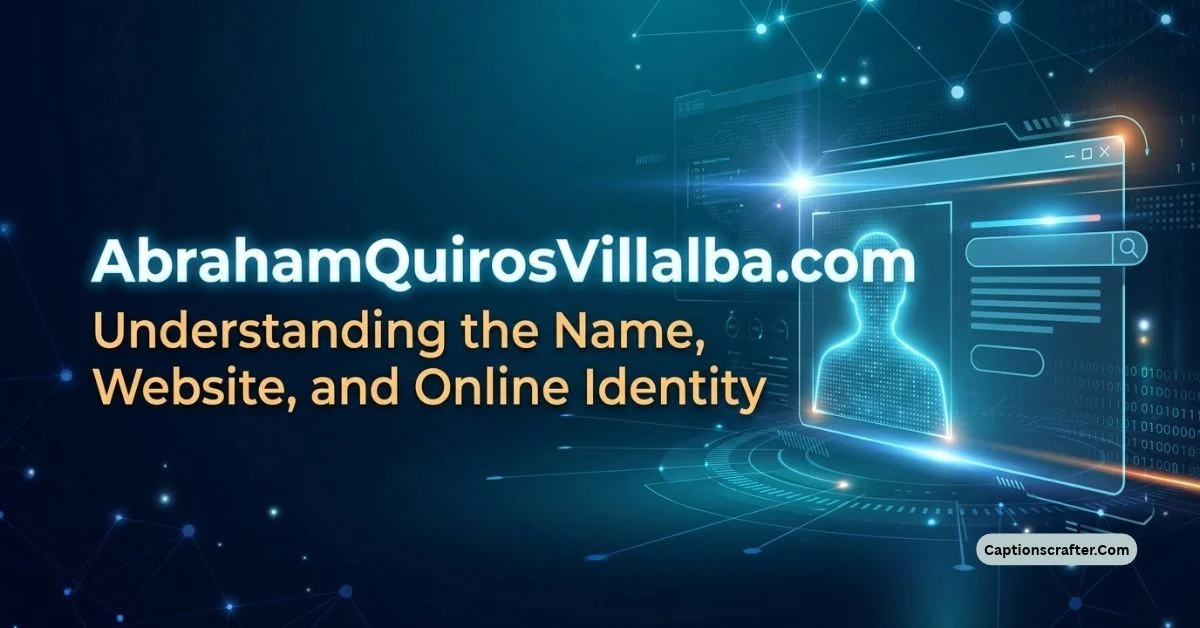
When people encounter an unfamiliar website or domain name, they often search for information to understand what it represents, who is associated with it, and whether it provides useful or trustworthy information. AbrahamQuirosVillalba.com is an example of a domain that may prompt questions about its identity, purpose, background, and relevance online.
A website address containing a personal name can represent many different things, including a personal portfolio, professional profile, author page, blog, or informational platform.
However, the domain name alone does not establish which of these purposes applies. Understanding the website requires looking at its actual content, ownership information, available contact details, and other reliable indicators.
This article explores the meaning and possible significance of this domain, how personal-name websites work, and how to evaluate them responsibly.
It also explains how website names differ from internet slang, technical terminology, and expressions used in everyday digital conversations. The goal is to help readers understand the subject without making unsupported claims about the website or its owner.
1. Meaning and Definition
AbrahamQuirosVillalba.com is a domain name formed from the words Abraham, Quiros, and Villalba, followed by the .com extension. Its structure resembles a personal name combined with a common commercial internet domain.
A domain name is the human-readable address people enter into a browser to access a website. It serves as a convenient alternative to remembering the numerical IP address associated with a web server. Domain names can represent companies, organizations, individuals, online publications, and many other types of digital projects.
What does the name represent?
The name appears to follow the structure of a person’s full name. However, the exact identity associated with it, the reason it was registered, and the website’s intended audience cannot be established from the spelling alone.
The .com extension is widely used for commercial websites, personal websites, blogs, and general-purpose online platforms. Despite its historical association with commercial activity, a .com domain does not necessarily indicate that a website sells products or operates a business.
Understanding the domain structure
The address can be divided into three main elements:
- Abraham: The first part of the apparent personal name.
- QuirosVillalba: The remaining name components, written together without spaces.
- .com: The top-level domain used at the end of the web address.
Combining a name into a single domain is common because internet addresses generally do not use spaces. The domain may be selected to establish a recognizable online identity or make a particular website easier to find.
Why is the domain searched online?
People may search for this address to identify the website, learn about its content, verify a professional association, or determine whether it is relevant to their interests. Others may have encountered the name in an article, search result, online profile, or reference link.
The important distinction is that a domain name identifies an internet address, not necessarily a verified person, profession, or organization. Those details should be confirmed through reliable evidence.
2. Background and Possible Purpose
Personal-name domains have become common as individuals increasingly establish their presence on the internet. Professionals, writers, consultants, creators, researchers, and independent business owners often use their names to build a recognizable digital identity.
A domain such as AbrahamQuirosVillalba.com fits the general pattern of a name-based web address. Nevertheless, its specific history, registration date, original purpose, and ownership should be confirmed through appropriate sources rather than inferred from its format.
Why do people create personal websites?
A personal website can serve several practical purposes.
Professional identity: A person may use a website to present qualifications, experience, projects, publications, and professional achievements.
Content publishing: Writers and independent publishers can use their websites to share articles, guides, commentary, or educational resources.
Portfolio development: Designers, developers, photographers, and other creative professionals may showcase their work through a dedicated domain.
Business communication: A website can provide service descriptions, contact information, and links to other professional channels.
Personal branding: A consistent domain helps connect a person’s name with their online work and makes it easier for audiences to locate relevant information.
These are common uses of personal domains, not confirmed descriptions of this particular website.
How can readers investigate its background?
Readers who want to learn more should begin by opening the domain directly and reviewing the available pages. A homepage, About section, author biography, or contact page may provide useful context.
Domain registration records can sometimes reveal registration dates, registrar information, and technical details. However, privacy services may conceal the registrant’s personal information, and registration records alone do not prove that a website is legitimate.
Readers can also look for independent references, linked professional profiles, published work, and consistent identity details. The strongest conclusions come from multiple credible sources that support the same claims.
Ultimately, understanding the background of a personal-name website requires separating verified facts from assumptions. This approach helps readers avoid confusing a domain’s appearance with proof of its actual purpose or ownership.
3. Usage in Different Contexts: Online, Social Media, and Professional Fields
A domain name can appear in many different settings, and its meaning depends largely on the context in which it is used. AbrahamQuirosVillalba.com should therefore be understood as a web address rather than as an expression with one universal meaning across every communication platform.
In general online searches
Search engines may display a domain when users look for a person, website, article, or other related information. Someone seeing the address for the first time may search it to understand its purpose or establish whether it relates to a topic they are researching.
Search results can offer useful clues, but snippets and automatically generated summaries should not be treated as definitive evidence. Readers should examine the underlying pages and check whether the information is supported.
In professional settings
A personal-name domain may be included in a résumé, business card, email signature, portfolio, or professional biography. In these situations, it usually serves as a link to additional information about the person or their work.
Before relying on a website for professional decisions, readers should check whether the qualifications, employment history, publications, or services mentioned on it can be independently verified.
On social media
People sometimes share personal websites through Instagram biographies, TikTok profiles, Facebook posts, LinkedIn pages, and other social channels. A linked domain can provide more space for information than a short social media biography.
However, the presence of a link in a profile does not automatically verify the identity of the account holder. Users should check account history, official links, and other available evidence when identity matters.
In digital publishing
Authors and publishers may use personal domains to host articles, resource pages, author biographies, or links to published work. If this website contains such material, readers should evaluate individual articles according to their accuracy, clarity, sourcing, and relevance.
In communication and research
The domain may also appear in emails, messages, discussion forums, or reference lists. Its function in those settings is generally navigational: it directs readers toward a web resource.
In every context, the key question is not simply what the name looks like, but what the linked website actually contains and whether its claims can be trusted.
4. Meaning in Chat, WhatsApp, Instagram, and TikTok
People frequently encounter unfamiliar words, abbreviations, and web addresses in digital conversations. It is therefore understandable that someone might wonder whether AbrahamQuirosVillalba.com has a special meaning in messaging applications or social media.
There is no established reason to interpret this domain as a standard texting abbreviation or universally recognized internet slang. Its visible structure indicates a website address rather than a conventional chat expression.
In chat messages
If someone sends the domain in a private message, they may simply be sharing a website they want another person to visit. The purpose could be informational, professional, promotional, or personal.
For example:
- “Here is the website I mentioned: AbrahamQuirosVillalba.com.”
- “Can you check whether this page contains the information we need?”
- “I found this domain while researching a topic.”
These examples illustrate possible uses of a website address. They do not establish what the actual website contains.
On WhatsApp
A domain shared through WhatsApp generally functions as a clickable link. Depending on the application and website configuration, a preview may display the page title, image, or a short description.
Before opening an unfamiliar link, users should check its spelling and consider whether the sender and context are trustworthy. Unexpected links that request passwords, payment details, downloads, or sensitive information deserve particular caution.
On Instagram
A personal website may be included in an Instagram biography or shared in a message or story. Users can follow the link to explore content outside the platform.
A domain appearing in an Instagram profile does not necessarily mean the website belongs to a verified public figure. Verification requires additional evidence.
On TikTok
TikTok users may share websites to direct viewers toward articles, portfolios, resources, or other online destinations. The domain’s role remains the same: it identifies a website rather than functioning as a special TikTok expression.
How should users interpret it?
The safest interpretation is straightforward: treat AbrahamQuirosVillalba.com as a domain name unless the surrounding conversation provides a different, clearly supported explanation.
Do not assume that it has a hidden romantic meaning, secret code, or trending slang definition merely because it appears in a message. Context matters, and unsupported interpretations can create unnecessary confusion.
5. Meaning in Physics, Medical Terminology, and Aircraft Terminology
The same sequence of letters can occasionally resemble a technical term, acronym, surname, or product name. This can lead people to search for a phrase across unrelated fields, especially when they are unsure where they encountered it.
However, AbrahamQuirosVillalba.com is formatted as a domain name. There is no established basis for treating the complete address as a standard term in physics, medicine, or aviation.
Physics
Physics uses specialized vocabulary for concepts such as energy, force, motion, acceleration, electric fields, and electromagnetic radiation. It also uses abbreviations and symbols that have specific meanings within particular contexts.
A personal-name domain does not become a physics term simply because it appears in a scientific discussion. If the address is referenced in a physics article, its relevance would depend on the content of that page, such as whether it provides educational material or discusses a scientific topic.
Readers should distinguish between the website’s name and any scientific concept explained on the website.
Medical terminology
Medical terminology includes names of conditions, anatomical structures, treatments, medications, diagnostic procedures, and clinical measurements. These terms often require precise definitions and careful interpretation.
The domain itself should not be interpreted as a diagnosis, treatment, medical abbreviation, or recognized clinical term. If a page associated with the address discusses health information, readers should assess the specific claims and consult qualified healthcare professionals for personal medical decisions.
A website’s domain name alone cannot establish medical authority or the accuracy of its health content.
Aircraft and aviation terminology
Aviation uses technical designations for aircraft models, flight instruments, navigation systems, communication procedures, and safety requirements. Some aircraft and aviation products may also be named after people or companies.
Nevertheless, the appearance of a personal name in a web address does not establish an aviation connection. Such a connection would need to be supported by the website’s actual content or reliable aviation references.
Why these distinctions matter
Searching one unfamiliar term across several fields can produce irrelevant results. To find an accurate answer, users should consider where they encountered the term, the subject being discussed, and the spelling of the expression.
For this domain, the clearest starting point is to investigate the website itself rather than assign it a technical definition without evidence.
6. Common Misconceptions About the Domain
Unfamiliar websites can generate incorrect assumptions, particularly when their names resemble personal identities or professional brands. Understanding a few common misconceptions helps readers evaluate AbrahamQuirosVillalba.com more carefully.
Misconception 1: The domain proves a person’s identity
A website containing a personal name may suggest a connection to an individual, but the name alone does not prove ownership or identity. Verification requires credible supporting information, such as consistent professional profiles or reliable first-party disclosures.
Misconception 2: Every .com website is a business
Although .com is historically associated with commercial activity, it is widely used for personal sites, blogs, informational projects, and other purposes. The extension does not establish whether a website sells anything.
Misconception 3: A website address is an internet slang term
Some online expressions have meanings that are very different from their literal spelling. However, not every unfamiliar string of characters is slang. A domain formatted with a web extension should ordinarily be interpreted as an internet address unless there is clear evidence of another use.
Misconception 4: A professional-looking website is automatically trustworthy
A polished design, confident writing, and professional photographs can make a site appear credible. These features do not guarantee that its claims are accurate, that its owner is who they claim to be, or that its services are reliable.
Readers should examine independent evidence, contact information, relevant credentials, and the quality of published material.
Misconception 5: Search-engine visibility confirms legitimacy
A website appearing in search results means that a search engine has indexed or displayed it. It does not constitute an endorsement or a guarantee of safety.
Similarly, a page that is absent from search results is not necessarily fraudulent; it may be new, restricted, or poorly indexed.
Misconception 6: Domain registration details tell the whole story
Registration records can provide useful technical information, but they may contain privacy-protected details and do not necessarily reveal the website’s real-world purpose.
The best approach is to combine direct inspection with independent verification and sensible online safety practices. Avoid drawing strong conclusions from a domain name alone.
7. Similar Terms and Alternatives
When investigating an unfamiliar website, it helps to understand the difference between a domain name and related internet terms. Although these expressions are connected, they do not mean exactly the same thing.
Domain name
A domain name is the readable address used to locate a website, such as AbrahamQuirosVillalba.com. It identifies the web destination, although the content hosted there may change over time.
Website
A website is a collection of related web pages and resources accessible through a domain or other web address. A domain can lead to a homepage containing multiple pages, articles, images, and navigation links.
URL
A URL, or Uniform Resource Locator, identifies a particular online resource. It can include the domain, a protocol such as HTTPS, and a path to a specific page.
For example, a hypothetical address such as https://example.com/about contains a domain and a path pointing toward an About page.
Personal brand
A personal brand is the public identity a person develops through their professional work, reputation, communication, and online presence. A personal website can support that identity, but the domain and the brand are not interchangeable concepts.
Author profile
An author profile presents information about a writer, contributor, or publisher. It may include a biography, published work, credentials, and links to other resources.
A personal-name domain could host an author profile, but that possibility must not be mistaken for a confirmed description of this particular website.
Portfolio website
A portfolio website showcases examples of someone’s work, skills, projects, or achievements. It is often used by creative professionals and people seeking employment or clients.
Online alias or username
A username is an identifier used on a particular platform or service. It may resemble a person’s real name, but it does not necessarily identify a website or prove someone’s legal identity.
These distinctions are useful when searching for a person or resource. Identifying the type of digital reference first makes it easier to select the right verification method and avoid mixing unrelated information.
8. How to Respond When Someone Shares the Website
If a friend, colleague, or unfamiliar account sends AbrahamQuirosVillalba.com, the best response depends on why the link was shared. There is no universal reply because a website address is not itself a question or an emotional statement.
When you are curious
Ask the sender what the website is about or why they recommend it.
Possible replies include:
- “What can I find on this website?”
- “Could you explain why you shared this link?”
- “Is there a particular page you want me to read?”
These questions invite clarification without making assumptions about the website’s purpose.
When the link is work-related
If a colleague shares the domain as a professional resource, respond with a clear question about its relevance.
For example, you could ask whether it contains a specific article, project, or reference needed for your work. If the information will influence an important decision, verify the details independently.
When the sender is unfamiliar
You do not have to open an unexpected link immediately. You can ask the sender to explain its purpose or provide the relevant information directly in the message.
If the message appears suspicious, contains unusual urgency, or requests sensitive details, avoid interacting with the link until you can verify its legitimacy.
When you need to check credibility
Review the website’s content, About page, contact information, and any claims about professional qualifications. Look for independent confirmation where appropriate.
Be cautious if the website requests payment or sensitive information without a clear reason. Use secure payment channels and avoid sharing passwords, authentication codes, or confidential information through unverified links.
When you simply need clarification
A brief, neutral response is usually sufficient. There is no need to invent a special meaning or give the sender a complicated explanation.
The key is to respond to the context in which the domain was shared. Asking a direct question is often more useful than guessing what the sender intended.
9. Differences From Similar Words and Digital References
AbrahamQuirosVillalba.com can be confused with several other types of online identifiers, particularly when people encounter it outside a browser. Understanding these differences makes searches and conversations more precise.
Domain name versus person’s name
A person’s name refers to an individual, while a domain name identifies an internet address. The two may be related, but they are not identical. Someone can register a domain containing a personal name without that fact alone proving that the named individual registered it.
Domain name versus company name
A company name identifies a business or legal entity, whereas a domain directs users to an online destination. A business may use a different domain from its registered name, and multiple websites may discuss the same business.
Domain name versus acronym
An acronym is formed from the initial letters of a series of words, while this address appears to be a name-based domain. Without evidence of a recognized acronym, it should not be expanded into an invented phrase.
Domain name versus keyword
A keyword is a word or phrase people enter into a search engine to find information. The full domain may be used as a search query, but its role changes depending on whether someone is navigating to a site or researching the address.
Domain name versus social media handle
A social media handle identifies an account on a particular platform. A domain identifies a website address. A person may use matching names across a website and several social media accounts, but matching names alone do not prove that the accounts share the same owner.
Domain name versus verified source
A verified source is one whose identity, authority, or claims have been supported through appropriate evidence. A domain is simply an address and should not automatically be treated as a reliable source.
These distinctions matter because digital names can be reused, imitated, or associated with different entities. Accurate interpretation requires examining the context and verifying the relationship between the name and the information presented.
10. Relevance in Online Conversations and Dating Apps
Personal websites sometimes appear in conversations on dating apps, messaging services, and social networking platforms. A person may share a website to introduce themselves, showcase professional work, provide background information, or direct someone to a project.
If AbrahamQuirosVillalba.com appears in a dating profile or private conversation, its presence does not automatically reveal a romantic meaning or establish the identity of the person sharing it.
Why might someone share a personal website?
Someone might want to provide additional information about their interests, professional activities, writing, or creative projects. A website can offer more detail than a short dating profile allows.
However, these are general possibilities rather than confirmed uses of this specific domain.
How should you interpret the link?
Start with the surrounding conversation. Did the person introduce the website as a portfolio, an article, or a way to learn more about them? Their explanation can help establish the intended purpose.
Even when a website looks professional, remember that its contents may be self-published. A biography or photograph does not independently verify the identity of the person who sent the link.
Dating-app safety considerations
When communicating with someone you have not met, take sensible precautions:
- Avoid sharing your home address, financial information, passwords, or verification codes.
- Be cautious if someone quickly asks for money, investments, gift cards, or financial assistance.
- Verify important identity claims through independent and appropriate means.
- Avoid downloading unexpected files or entering login details after following unfamiliar links.
- Keep conversations on a trusted platform until you are comfortable with the person’s identity and intentions.
These precautions apply to all unfamiliar websites, not just personal-name domains.
What if you want to respond?
You can simply ask what the website contains or which page the person wants you to see. If you are interested in learning more about them, ask ordinary questions and let the conversation develop naturally.
Do not infer someone’s personality, relationship intentions, honesty, or romantic interest from a domain name alone. Those judgments require broader context and consistent behavior.
Ultimately, a website can provide useful background information, but it should complement rather than replace thoughtful communication and appropriate online safety practices.
Conclusion
AbrahamQuirosVillalba.com is structured as a personal-name domain using the widely recognized .com extension. Its exact purpose, ownership, background, and content should be established through direct inspection and reliable supporting evidence rather than assumptions based on the name alone.
Understanding the distinction between a domain, a personal identity, an online profile, and a verified information source helps readers interpret unfamiliar links more accurately.
The address should not automatically be treated as internet slang, a technical term in physics or medicine, an aviation expression, or a phrase with a hidden meaning in dating conversations.
If you encounter this domain in a search result, message, professional profile, or social media post, begin by identifying the context in which it appears.
Review the website’s actual content, check relevant claims, and follow sensible online safety practices before sharing sensitive information or relying on its information.
Ultimately, the most reliable way to understand AbrahamQuirosVillalba.com is to evaluate what the website demonstrably contains and verify important claims using trustworthy sources.