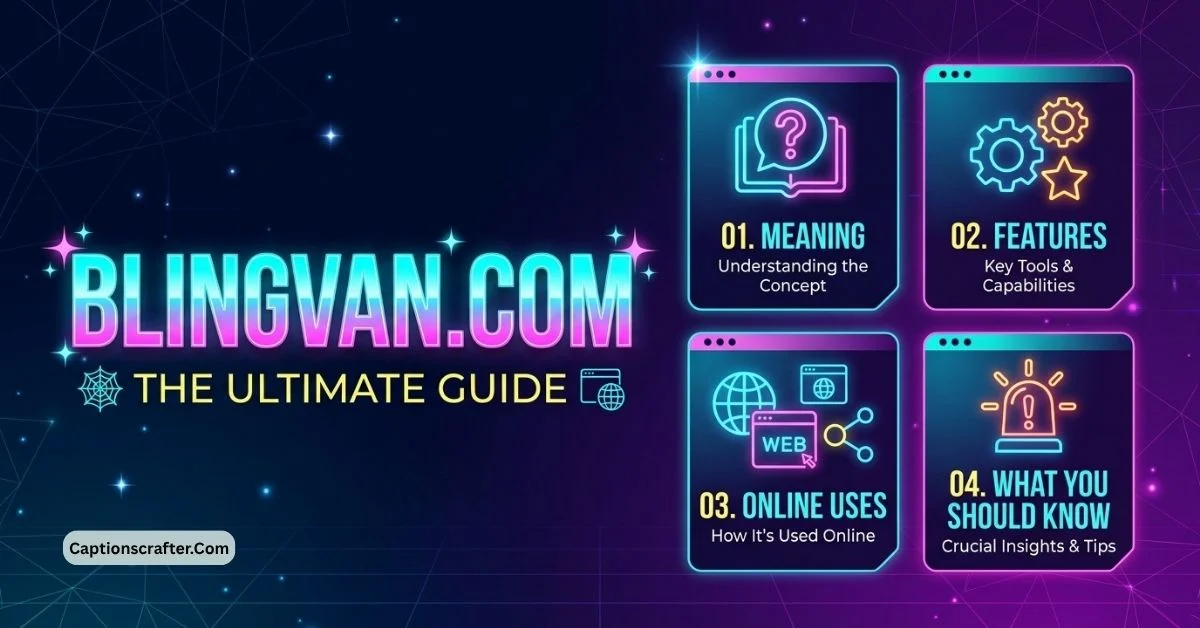
When people come across an unfamiliar website or domain name, they often search for its meaning, purpose, and usefulness before deciding whether to explore it. Blingvan com is one such keyword that may attract attention from users looking for information about a website, an online platform, or a term they have encountered on the internet.
Understanding an unfamiliar domain starts with identifying what its name represents, what services it may offer, and whether reliable information is available about its ownership and functionality. It is important to distinguish between a website’s actual purpose and assumptions based only on its name.
The word bling is commonly associated with sparkle, jewelry, fashion, and eye-catching accessories, while van can refer to a vehicle or appear as part of a brand name. However, these individual meanings do not establish what Blingvan.com actually does.
In this guide, we will explore the keyword’s possible meaning, online context, related terminology, common misunderstandings, and practical safety considerations. The goal is to help readers understand the term clearly without presenting unverified information as fact.
1. Blingvan Com: Meaning and Definition
Blingvan.com is a domain-style keyword made up of a distinctive name and the familiar internet extension “.com.” To understand it properly, it helps to separate the name itself from the website that may use it.
A domain name is a human-readable web address that allows people to locate a website without remembering a numerical internet address. The “.com” extension is widely used by commercial businesses, personal projects, online services, and many other types of websites. However, having a .com address does not automatically mean that a website is a registered company, an online store, or a trusted service.
The word bling is an informal English term associated with flashy jewelry, shiny accessories, luxury fashion, and decorative items. It is frequently used in entertainment, music, and popular culture. The word van can refer to a type of vehicle or form part of a business or brand name.
When combined, these words could serve as a distinctive brand identity. Nevertheless, the name alone does not confirm whether the website relates to fashion, transportation, entertainment, shopping, or another subject.
What does Blingvan Com actually mean?
The most accurate general explanation is that Blingvan Com refers to a domain-style name that requires additional verification to establish its actual purpose. Without confirmed information about the website’s owner, published content, or services, assigning it a specific meaning would be speculation.
People searching for this keyword may want to discover:
- The website’s main purpose and available features.
- Whether it provides products, information, or online services.
- Whether the website is legitimate and safe to visit.
- Whether the name represents a brand, business, or digital platform.
- How to access the website and understand its content.
The key distinction is that a domain name identifies an online destination; it does not, by itself, explain everything that destination offers.
2. Background and Possible Origins of Blingvan Com
Understanding the background of a website usually involves examining its domain registration, published information, branding, and online presence. In the case of Blingvan.com, the exact origin and history should not be assumed without verifiable evidence.
Domain names are often created to make businesses and projects easier to recognize. Some combine two familiar words, while others use invented names designed to stand out in search results. A memorable name can help people recognize a brand, but memorability does not necessarily indicate credibility or popularity.
Why might someone choose a name like Blingvan?
There are several possible reasons a person or organization might choose a distinctive name like this:
Brand recognition: A short, unusual name can be easier to distinguish from competing websites.
Creative identity: Combining familiar words can create a name that sounds modern, playful, stylish, or memorable.
Online discoverability: A unique domain may help users find a particular website when they search for its exact name.
Business flexibility: A broad name can potentially accommodate different products, services, or content categories.
These are general explanations of domain naming practices, not confirmed details about the history of Blingvan.com.
How to investigate its background
If you want to understand the website’s real origin, start by entering the domain into your browser carefully. Check whether the site loads and whether it provides an About page, contact information, terms of service, or privacy policy.
You can also use a domain registration lookup, such as ICANN’s registration data lookup service, to investigate available registration details. Keep in mind that some registrant information may be protected by privacy services, and a registration date alone does not establish whether a website is trustworthy.
Look for consistent branding and independently verifiable business information. Be cautious if a website makes extraordinary claims, hides essential policies, or pressures visitors to provide personal information immediately.
A reliable assessment should be based on evidence rather than the name’s appearance. Until its background is established, Blingvan.com is best treated as an identifiable domain name whose specific history remains unconfirmed.
3. Blingvan Com in Different Contexts
The meaning of a website name can change depending on where someone encounters it. A domain mentioned in an advertisement may serve a different purpose from the same domain appearing in a social media comment or a business discussion.
In general online searches
People may enter Blingvan.com into a search engine because they have seen the name somewhere and want to learn more. They might be looking for an official website, product information, customer experiences, or details about a particular service.
A search query does not necessarily mean the website is widely known. Sometimes users search for a domain simply because they want to verify an unfamiliar link.
In business and marketing
Businesses frequently use distinctive domain names in advertisements, email signatures, promotional campaigns, and digital marketing materials. A domain can direct potential customers to a product catalog, company profile, booking page, or informational resource.
However, the presence of a domain in a promotional message does not establish that it represents a legitimate company. Users should verify the business behind the link before making purchases or sharing sensitive details.
In technology and digital communication
A domain name can appear in messages, website analytics, referral reports, online discussions, and technical documentation. In these settings, the name generally identifies a website or a source of web traffic rather than acting as a word with a special technical definition.
In professional communication
If a colleague mentions Blingvan.com in a work email or meeting, the appropriate response is to ask what the website is used for and whether it is an approved resource. Avoid assuming that an unfamiliar domain is an official company tool.
The context in which the name appears is therefore important. Its exact purpose should be established through the website’s content and reliable supporting information, not through assumptions about the name itself.
4. Blingvan Com Meaning in Chat, WhatsApp, Instagram, and TikTok
Online conversations frequently include website names, abbreviations, usernames, and links that may not be familiar to everyone. If you encounter Blingvan.com in a chat or social media post, the first step is to understand how the sender used it.
Meaning in chat and text messages
In ordinary texting, a domain name is usually shared to direct someone to a website. A person might send a link while discussing a product, sharing a resource, or asking a friend to look at something online.
For example:
- Friend A: Have you seen this website?
- Friend B: No, what is it for?
- Friend A: I’m trying to find out more about it.
This example illustrates how someone might discuss an unfamiliar domain. It does not establish that Blingvan.com has a particular service or function.
There is no established, widely recognized texting abbreviation called “Blingvan” that can be confirmed from the name alone.
Meaning on WhatsApp
On WhatsApp, a domain may appear in a private message, group chat, business conversation, or forwarded message. The sender may intend to share information or recommend a website.
Before opening a link, consider whether you recognize the sender and whether the message makes sense in context. Unexpected links accompanied by urgent requests, suspicious offers, or demands for login details deserve additional caution.
If you are uncertain, ask the sender to explain the website before visiting it.
Meaning on Instagram
Instagram users commonly share website links through profiles, stories, direct messages, and promotional content. A domain might be connected to a creator’s project, a business campaign, or an external resource.
If you see Blingvan.com in a profile or post, its appearance does not automatically prove that the account owns the website or officially represents it. Check for consistent branding and independent confirmation.
Meaning on TikTok
On TikTok, website names may appear in video captions, comments, creator biographies, or discussions about online trends. Users sometimes search for a domain after seeing it mentioned in a video.
However, a name appearing in a viral video does not establish its authenticity or purpose. Verify important claims independently, especially when money, downloads, or personal information are involved.
In short: In chat and social media, Blingvan.com should generally be interpreted as a website or domain reference unless the surrounding conversation provides a more specific, verified meaning.
5. Blingvan Com Meaning in Physics, Medical, and Aircraft Terminology
One common source of confusion when researching unfamiliar keywords is assuming that every term has a technical definition across multiple professional fields. In reality, many names are specific to websites, brands, or individual projects and have no established scientific meaning.
There is no verified basis here for identifying Blingvan as a standard term in physics, medicine, or aviation. The distinctions below help clarify how to interpret the keyword in these contexts.
Meaning in physics
Physics uses specialized terminology to describe matter, energy, motion, forces, waves, and other natural phenomena. Scientific terms generally have definitions that can be traced to established textbooks, technical publications, or recognized research.
“Blingvan” is not identifiable from the name alone as a standard physics concept, formula, unit, or physical law. If the term appears in a physics-related article, it may be a product name, project label, website reference, or spelling error.
For example, if a document discusses a scientific instrument and includes an unfamiliar website address, the domain should not be mistaken for the instrument’s technical name.
Meaning in medical terminology
Medical terminology includes standardized names for diseases, symptoms, treatments, diagnostic procedures, and anatomical structures. These terms are generally supported by recognized medical references and professional usage.
There is no established medical definition of Blingvan that can be reliably assigned based solely on the keyword. If you encounter it on a health-related website, examine the actual medical information rather than assuming the domain name represents a diagnosis or treatment.
Never rely on an unfamiliar website’s name as evidence that its medical advice is accurate. Check the authors’ qualifications, supporting references, and relevant guidance from recognized healthcare organizations.
Meaning in aircraft and aviation terminology
Aviation uses specific terminology for aircraft components, flight operations, navigation, maintenance, and safety procedures. Technical abbreviations and designations can have precise meanings within aviation documentation.
Blingvan is not established here as a standard aircraft designation, aviation abbreviation, or recognized flight-related term. If it appears in an aviation discussion, its meaning would need to be determined from the surrounding material.
Why these distinctions matter
A domain name can appear in almost any subject area without becoming a recognized technical term in that field. Before accepting a definition, check whether it appears in an authoritative source relevant to the discipline.
This approach prevents confusion between website branding and professional terminology and helps readers avoid repeating unsupported explanations.
6. Common Misconceptions About Blingvan Com
Unfamiliar website names often attract speculation, particularly when limited information is available. Understanding the most common misconceptions can help readers separate confirmed facts from assumptions.
Misconception 1: The name explains exactly what the website does
A domain’s wording can suggest a possible theme, but it does not prove the site’s purpose. Although “bling” is associated with fashion and decorative accessories, that association is insufficient to conclude that Blingvan.com is a jewelry store or fashion platform.
Misconception 2: Every .com website is a registered business
The .com extension is used by companies, individuals, organizations, and personal projects. Its presence does not confirm that the website belongs to a legally registered company.
If business identity matters, check independently verifiable registration details and contact information where applicable.
Misconception 3: A website is safe because it looks professional
A polished design, attractive logo, and convincing writing can make a website appear credible. However, appearance alone cannot establish security, honest business practices, or the legitimacy of its claims.
Check the domain carefully, review the site’s policies, and avoid providing sensitive information until you have sufficient confidence in the service.
Misconception 4: Every unfamiliar domain is a scam
An unfamiliar website is not automatically fraudulent. New projects, small businesses, personal websites, and niche services may have limited visibility.
The correct approach is to evaluate available evidence rather than immediately trusting or dismissing the site.
Misconception 5: Social media mentions prove popularity
A domain appearing in a post or video does not necessarily mean it is widely used, officially endorsed, or well reviewed. Online mentions may be promotional, mistaken, or unrelated to the site’s actual owner.
Misconception 6: Search results always provide accurate definitions
Search engines may show incomplete descriptions, third-party summaries, outdated information, or pages discussing a different subject with a similar name. Compare information from reliable sources before accepting a claim.
The main lesson: Treat Blingvan.com as an unverified website identity until reliable evidence establishes its purpose, ownership, and reputation. Careful verification is more useful than guessing based on its name.
7. Similar Terms and Alternatives to Blingvan Com
When researching an unfamiliar domain, it helps to understand related terms used in digital communication. These terms can make it easier to describe a website accurately, search for additional information, and explain what you have found to someone else.
Although Blingvan.com is a distinctive domain-style name, it should not be confused with general internet terminology or another brand with a similar spelling.
Commonly related terms
| Term | Meaning |
|---|---|
| Domain name | A readable name used to identify an internet destination. |
| Website | A collection of related web pages accessible online. |
| URL | The complete address used to locate a resource on the web. |
| Brand name | A name used to identify a business, product, service, or project. |
| Web platform | An online environment that provides particular tools or services. |
| Landing page | A web page designed around a particular message, offer, or action. |
| Online directory | A resource that organizes listings of websites, businesses, or other information. |
These terms describe different aspects of the internet. For instance, a domain name may direct visitors to a website, while a URL can identify a specific page within that website.
Are there alternative meanings of Blingvan?
The name may be interpreted differently depending on where it appears. It could function as a brand label, a username, a project name, or a reference to a domain. However, none of these possibilities should be presented as the confirmed identity of Blingvan.com without supporting evidence.
If you are searching for alternatives, first identify what you actually need. Someone looking for a domain lookup service needs a different resource from someone looking for an online shopping platform or a website safety checker.
For domain information, an established registration lookup service can help reveal available registration data. For security concerns, a reputable website reputation checker may provide additional signals. Neither type of service guarantees that a website is entirely safe.
How to avoid confusing similar names
Check the exact spelling, domain extension, and complete URL. Small differences in spelling can lead to completely different websites.
Do not assume that two domains are affiliated simply because their names look alike. Verify any claimed relationship through official sources.
Ultimately, understanding related terminology helps you research Blingvan.com more effectively without inventing an alternative definition or confusing it with an unrelated service.
8. How to Respond When Someone Mentions Blingvan Com
If someone sends you Blingvan.com or mentions it during a conversation, you do not need to know everything about the website immediately. A simple question can clarify why the person shared it and whether further investigation is necessary.
The most appropriate response depends on the situation, your relationship with the sender, and whether you recognize the website.
Responses for casual conversations
If a friend mentions the domain, you could respond naturally:
- What is that website about?
- Have you used it before?
- Can you explain what it does?
- Is there a particular page you want me to check?
- Do you know whether it is an official website?
These responses show interest without pretending to understand something unfamiliar.
Responses for WhatsApp and social media
If someone sends the domain in a direct message, consider asking for context before clicking.
For example:
Sender: Check out Blingvan.com.
You: What does the website offer? I want to understand it before opening the link.
If the sender explains its purpose, you can independently verify the information. If the message seems unusual, contact the person through a separate, trusted channel to confirm that they actually sent it.
Responses in professional settings
In a workplace conversation, use a clear and neutral response:
- Could you share the purpose of this website?
- Is this an approved resource for our project?
- Do we have an official reference for this platform?
- Can we verify the website before using it?
Professional communication benefits from asking precise questions rather than making assumptions.
What if someone asks whether it is legitimate?
Avoid giving an immediate yes-or-no answer without evidence. You can explain that the domain’s name alone does not establish its trustworthiness and that its ownership, content, and security should be checked.
Do not enter passwords, payment information, or confidential work details simply because someone recommends a website.
A sensible response is one that acknowledges the unknown, asks for useful context, and prioritizes verification. This approach works equally well in personal chats, business discussions, and online communities.
9. Differences Between Blingvan Com and Similar Words
Understanding the difference between a website name, a brand, and a slang expression can prevent incorrect interpretations.
Blingvan versus bling
Bling is a recognized informal English word associated with conspicuous jewelry, shiny accessories, and flashy style. It can also describe an extravagant appearance or a glamorous aesthetic.
Blingvan, by contrast, is the specific name being investigated here. The meaning of the word bling does not establish the meaning, services, or business category of the complete domain.
Blingvan versus a domain name
A domain name is a general technical term for an internet address component. Blingvan.com is an example of a domain-style name.
The distinction is similar to the difference between the word company and the name of a particular company. One is a general category; the other identifies a specific entity.
Blingvan versus a URL
A URL identifies the location of a web resource. For example, a URL may include a protocol, domain, and additional path information.
A domain alone does not necessarily specify which page a visitor will reach. A complete URL can identify a more specific destination.
Blingvan versus a texting abbreviation
Common texting abbreviations, such as LOL or BRB, have widely understood meanings in casual conversations. An unfamiliar domain name should not automatically be treated as an abbreviation with a hidden meaning.
Unless the surrounding conversation establishes another interpretation, Blingvan.com is best understood as a domain reference rather than a recognized texting acronym.
Why the distinction is important
These differences matter because people sometimes combine a word’s dictionary meaning with assumptions about an entire website. That can create misleading explanations.
For accurate research, keep the following distinctions in mind:
- A word’s meaning does not prove a website’s purpose.
- A domain does not automatically represent a verified business.
- A brand name does not necessarily describe the product or service offered.
- A URL is an address, not proof that the destination is trustworthy.
Using these distinctions makes it easier to explain unfamiliar websites accurately and communicate findings without spreading misinformation.
10. Blingvan Com in Online Conversations and Dating Apps
Website links can appear in almost any online conversation, including discussions on dating apps, friendship platforms, social networks, and interest-based communities. If Blingvan.com appears in one of these settings, its significance depends on the context in which it was shared.
When a link appears in a dating conversation
Someone might share a website while discussing a hobby, recommending a service, or moving a conversation to another platform. Sharing a link is not automatically suspicious, but it is sensible to understand its purpose before opening it.
For example, if a new match sends an unfamiliar domain without explanation, you can ask what the site is and why they recommend it.
A genuine explanation should allow you to understand the context without pressure.
Warning signs to watch for
Be particularly cautious if someone you have recently met online:
- Insists that you register on an unfamiliar website immediately.
- Requests your dating-app password or other account credentials.
- Encourages you to provide payment details without a clear reason.
- Promises guaranteed financial returns or unusually large rewards.
- Pressures you to move money, purchase gift cards, or share verification codes.
- Becomes aggressive when you ask reasonable questions.
These behaviors can occur in online scams, but their presence or absence cannot be determined from a domain name alone.
How to protect your privacy
Avoid sharing sensitive personal information with someone you have only recently met. Do not upload identity documents, provide financial details, or reuse passwords on unfamiliar websites.
If a website requires an account, review its privacy policy and understand what information it collects. Use a unique password and enable additional account security where available.
If the link appears suspicious, do not open it. You can instead ask the sender for an explanation or independently search for the website’s official information.
Does Blingvan have a specific dating meaning?
There is no established dating-app meaning for Blingvan that can be confirmed from the name alone. Its appearance in a dating conversation would not automatically make it a flirting term, relationship abbreviation, or dating platform.
The safest interpretation is to treat it as an unfamiliar website reference until the sender provides context and the domain can be independently verified.
In online dating, clear communication and sensible privacy precautions are more valuable than trying to assign a hidden meaning to every unfamiliar name.
Conclusion
Blingvan.com is a domain-style keyword that may prompt questions about a website’s meaning, background, purpose, and reliability. Although its name contains familiar word elements, those elements do not establish what the website actually offers. It is therefore important to distinguish possible interpretations from confirmed information.
Whether you encounter the name in a search result, WhatsApp message, Instagram post, TikTok video, professional discussion, or dating conversation, start by examining the context and checking reliable sources. Review the website’s published information, verify any claimed business identity, and be cautious about sharing personal or financial details.
There is also no verified basis for treating Blingvan as a standard physics, medical, aviation, or texting term. Its exact purpose requires evidence from the website itself or other trustworthy references.
Ultimately, the best way to understand Blingvan.com is through careful research rather than assumptions. Verify what is known, recognize what remains uncertain, and make informed decisions before interacting with an unfamiliar online platform.

I Am Henry Collins writes creative caption ideas at captionscrafter.com, helping social media users find catchy, trendy, and engaging captions.