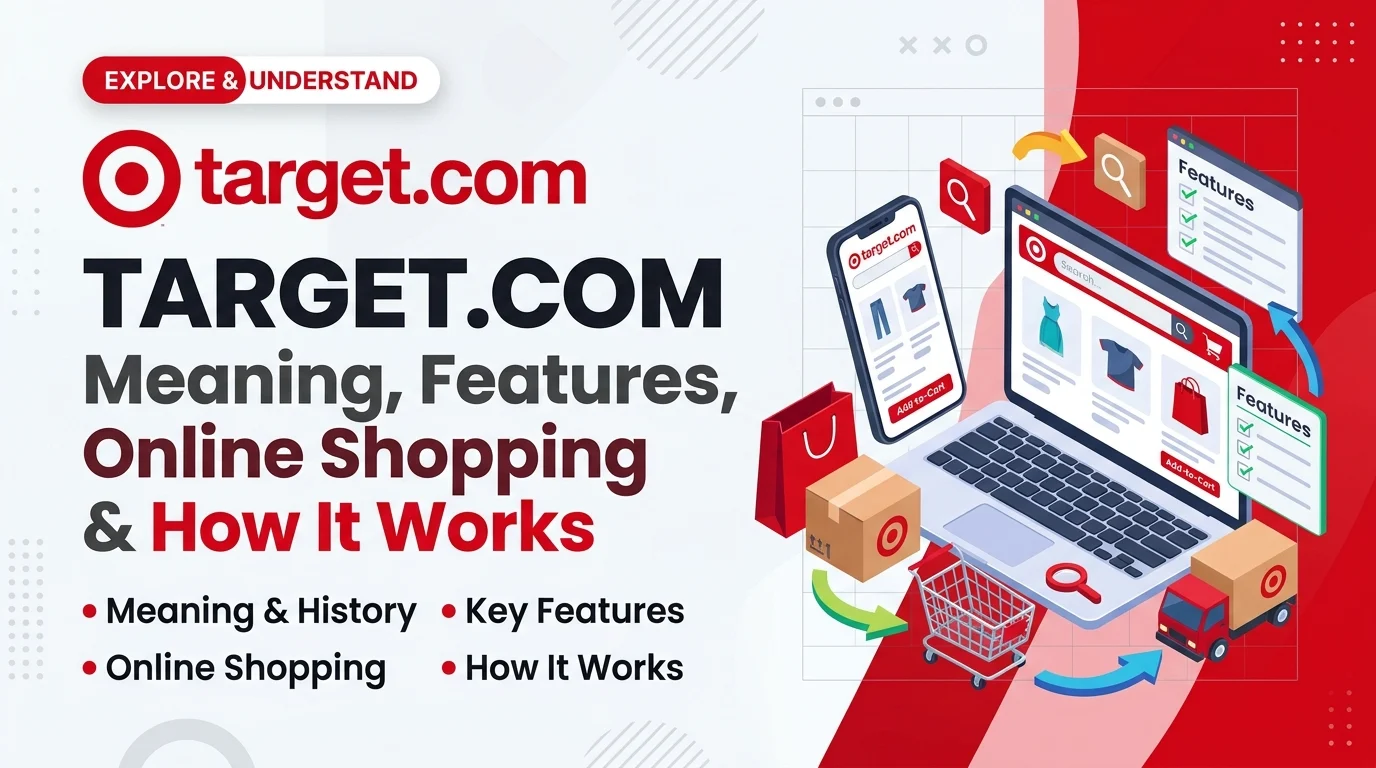
Target.com is the official online shopping website of Target, one of the well-known retail brands in the United States.
People frequently search for Target.com to learn about its services, explore available products, purchase everyday essentials, and understand how its online shopping platform works.
From clothing and electronics to groceries, home decorations, beauty products, and household supplies, the platform provides access to a wide range of shopping categories.
In today’s digital world, online shopping has become an important part of everyday life. Customers prefer convenient platforms where they can browse products, compare prices, place orders, and arrange deliveries without visiting physical stores.
Target.com serves this purpose by connecting customers with products and shopping services through its website.
Whether someone wants to understand what Target.com is, how to use its features, or how it differs from other online marketplaces, learning about the platform can make the shopping experience easier and more convenient.
1. Target.com Meaning and Definition
Target.com refers to the official online shopping platform operated by Target Corporation, an American retail company. It allows customers to explore products, view shopping categories, check product information, and purchase items through an internet-connected device.
The website is designed to provide a convenient shopping experience for people who prefer buying products online rather than visiting physical retail locations. Customers can browse different departments, search for specific items, and explore available purchasing options.
What Does Target.com Stand For?
The name consists of two simple parts:
- Target: The name of the retail company.
- .com: A domain extension commonly associated with commercial websites.
Together, Target.com identifies the company’s online shopping destination.
Unlike general internet marketplaces that primarily connect independent sellers with buyers, Target.com represents a retailer’s own digital shopping platform.
What Can People Find on Target.com?
The website covers several major shopping categories, including:
- Clothing and fashion accessories
- Electronics and technology products
- Furniture and home decorations
- Kitchen and dining essentials
- Beauty and personal care products
- Groceries and household supplies
- Toys, games, and entertainment products
- Baby products and children’s essentials
- Sports, outdoor, and seasonal merchandise
This variety makes the platform useful for customers with different shopping needs.
Who Uses Target.com?
Target.com is mainly intended for customers who want to shop for products offered by Target. Families, students, working professionals, homeowners, and everyday consumers may use the platform to find products that suit their budgets and lifestyles.
In simple terms, Target.com is the digital shopping destination of Target, allowing customers to discover and purchase a wide range of retail products online.
2. Background and History of Target.com
Understanding the background of Target.com requires looking at the development of Target Corporation and the growth of online shopping.
Target Corporation has its roots in American retail history. The company introduced its Target department store concept in 1962 in Roseville, Minnesota. Its original goal was to provide customers with an appealing shopping experience that combined quality products, attractive presentation, and affordable prices.
Over time, Target expanded its retail presence and developed a recognizable identity in the American shopping industry.
The Development of Online Shopping
As internet access became more common, traditional retailers started exploring opportunities to sell products through websites. Customers increasingly wanted to browse merchandise and purchase items without traveling to physical stores.
Target responded to this changing shopping environment by developing its online retail presence.
Target.com became an important part of the company’s digital strategy, allowing shoppers to access product information and shopping services through the internet.
Growth of Digital Retail Services
Online shopping has changed considerably over the years. Modern customers expect more than a simple product catalog. They want convenient ordering, flexible fulfillment options, useful product descriptions, and straightforward account management.
Target’s digital platform has developed around these expectations.
Its online shopping experience connects customers with various retail departments while supporting different shopping and fulfillment options, depending on product availability and location.
Target.com in the Modern Retail Industry
Today, Target.com represents an important part of Target’s overall retail business. It complements physical stores by giving customers another way to explore merchandise and complete purchases.
The website also demonstrates how traditional retailers can combine physical shopping locations with digital services.
For example, customers may discover a product online and choose an available store-related fulfillment option instead of having every purchase delivered to their homes.
This combination of digital convenience and physical retail access helps Target serve customers with different shopping preferences.
3. Usage of Target.com in Different Contexts
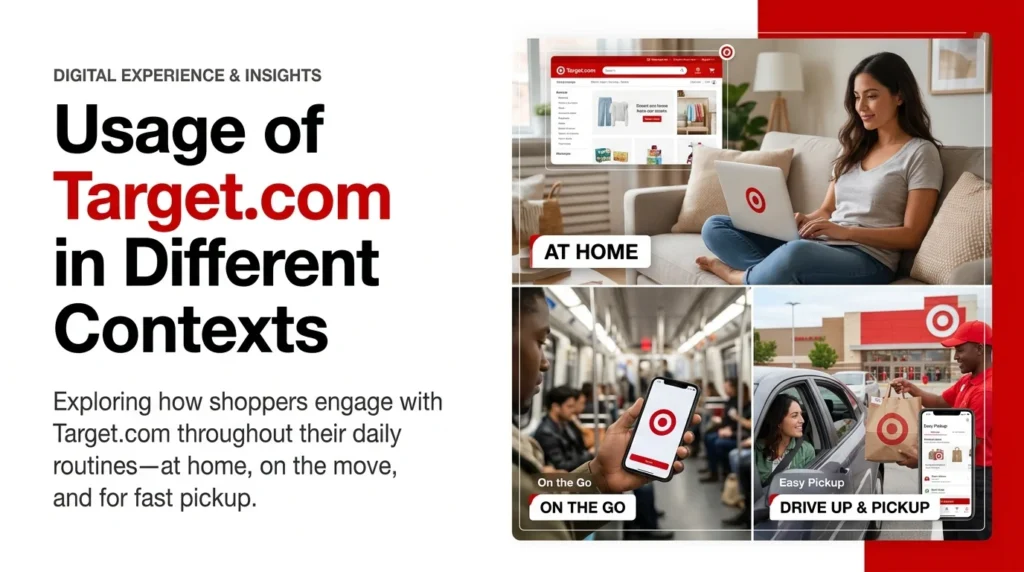
The term Target.com can appear in several situations, including online conversations, shopping discussions, business communication, and professional environments.
Although its primary meaning remains connected to retail shopping, the context determines what someone wants to communicate.
In Everyday Conversations
People commonly mention Target.com when discussing shopping plans, product searches, or online purchases.
Examples:
- I found a great kitchen organizer on Target.com.
- You can check Target.com for more options.
- I ordered my household supplies through Target.com.
- Target.com has several products worth comparing.
In these examples, the website is mentioned as a shopping destination.
In Social Media Discussions
Target.com may appear in Instagram posts, TikTok videos, Facebook discussions, and online shopping recommendations.
Content creators sometimes discuss affordable products, home organization ideas, fashion finds, beauty products, and seasonal shopping.
For example:
- My favorite home decor finds from Target.com.
- These affordable Target.com products are worth checking out.
- Sharing my latest online shopping discoveries.
The name helps viewers understand where the featured products can be found.
In Professional and Business Communication
In professional settings, Target.com may be referenced in discussions about retail operations, e-commerce, digital marketing, product availability, and customer shopping behavior.
For example:
- The product listing is available on Target.com.
- Customers can review the online product information.
- The digital retail platform supports the company’s online sales operations.
Retail analysts, marketers, suppliers, and business professionals may also mention the website when discussing e-commerce strategies.
In Customer Service Conversations
Customers might use the term when asking about an order, delivery, return, refund, or product listing.
Examples include:
- I purchased this item through Target.com.
- Can I check my order status online?
- Where can I find the return information?
Therefore, the term is useful in everyday shopping conversations as well as professional retail communication.
4. Target.com Meaning in Chat, WhatsApp, Instagram, and TikTok
People sometimes search for Target.com because they see the name in messages, social media captions, comments, or online recommendations.
Unlike internet slang, Target.com does not have a hidden texting meaning or special abbreviation. It refers to the official Target shopping website.
However, the way people use it can change depending on the platform.
Target.com in Chat and Text Messages
In private conversations, people usually mention Target.com when recommending products or sharing shopping information.
Examples:
Friend 1: Where did you get that lamp?
Friend 2: I ordered it from Target.com.
Another example:
Person 1: I need some affordable storage containers.
Person 2: You should look at Target.com.
Here, the name simply identifies the shopping website.
Target.com on WhatsApp
WhatsApp users may share product links, shopping recommendations, and order-related information.
For example:
- Check this product on Target.com.
- I found something interesting for your kitchen.
- Here is the link to the item I mentioned.
When someone sends a Target.com link through WhatsApp, they are generally directing another person to a product or shopping page.
Target.com on Instagram
On Instagram, the website may appear in product recommendations, shopping-related captions, reels, and lifestyle content.
Popular content themes include:
- Affordable home decoration ideas
- Everyday fashion inspiration
- Beauty product recommendations
- Kitchen organization products
- Seasonal shopping collections
For example, a creator might write:
My favorite affordable home finds from Target.com!
This tells followers where the featured products are associated with.
Target.com on TikTok
TikTok creators often use shopping-related content to share product discoveries and personal recommendations.
Target-related videos may feature product reviews, shopping hauls, home improvement ideas, and useful household purchases.
Common phrases include:
- Target.com shopping finds
- Things worth checking out at Target
- My latest Target shopping haul
- Affordable products for everyday living
The meaning remains consistent across these platforms: Target.com refers to Target’s online retail website, not a separate slang expression.
5. Target.com Meaning in Physics, Medical, and Aircraft Terminology
One reason people may become confused about the term Target.com is that the word “target” has different meanings in technical and professional fields.
However, it is important to distinguish the general word from the complete website name.
Target.com is not a recognized scientific, medical, or aviation abbreviation. Its established meaning is connected to Target’s online retail business.
Target.com in Physics
In physics, the word “target” can describe an object or material that receives a beam of particles, radiation, or other forms of energy.
For example, in experimental physics, researchers may direct particles toward a target material to observe interactions and collect measurements.
The word may also appear in discussions involving:
- Particle collision experiments
- Radiation interactions
- Laser experiments
- Material testing
- Scientific measurement
However, Target.com does not represent a standard physics formula, unit, or scientific principle.
Target.com in Medical Terminology
In healthcare, the word “target” is commonly used in discussions about treatment goals, biological targets, and specific areas of medical attention.
Examples include:
- Target cells
- Target organs
- Target therapy
- Target blood pressure
- Target treatment outcomes
A medical professional may use the word to describe a particular biological structure or therapeutic objective.
Nevertheless, Target.com itself is not a standard medical diagnosis, treatment, medication, or clinical abbreviation.
Target.com in Aircraft and Aviation Terminology
In aviation, the word “target” can describe an object or location identified by radar, surveillance equipment, or tracking systems.
For example, air traffic monitoring and military aviation may involve identifying and tracking specific targets.
Related expressions include radar targets, tracking targets, and designated targets.
However, Target.com is not an established aircraft model, aviation code, flight instrument, or standard technical expression.
Why Context Matters
The same word can have different meanings in different industries.
The word “target” may describe a scientific object, medical objective, or tracked aviation object. Adding “.com” changes the context by identifying an internet domain.
Therefore, people should avoid interpreting Target.com as a technical abbreviation without supporting evidence.
6. Common Misconceptions About Target.com
Several misunderstandings can develop when people encounter an unfamiliar website name or see it mentioned in online discussions.
Understanding these misconceptions makes it easier to recognize what the platform actually represents.
Misconception 1: Target.com Is an Internet Slang Term
Some users assume that unfamiliar words appearing in messages must have a special texting meaning.
However, Target.com is not a widely recognized slang abbreviation. It is the online shopping website associated with Target Corporation.
Misconception 2: Target.com Is a Separate Company
Target.com is not a completely independent retail brand unrelated to Target.
It is part of Target’s broader retail business and provides customers with access to its online shopping services.
Misconception 3: Every Product Is Always Available
Another misunderstanding is that every item shown online must be available for immediate purchase.
Product availability can depend on inventory, location, demand, and fulfillment arrangements. Customers should check the product page for the latest available information.
Misconception 4: Online Prices Are Always Identical to Store Prices
Customers sometimes assume that online and physical store prices are always the same.
However, pricing, promotions, and product availability may vary depending on the item, location, and applicable offers.
Checking the displayed price before completing a purchase is always a sensible step.
Misconception 5: Target.com Only Sells Household Products
Although the website offers many home and household essentials, its product categories are much broader.
Customers can explore fashion, electronics, groceries, beauty products, toys, furniture, and numerous other retail categories.
Misconception 6: Target.com Has a Hidden Technical Meaning
The addition of “.com” does not automatically make a term an abbreviation or technical expression.
In this case, it identifies an internet domain associated with a retail company.
7. Similar Terms and Alternatives to Target.com
Target.com belongs to the broader category of online retail websites. Several other platforms provide similar shopping experiences, although their product selection, business models, and services can differ.
Understanding these alternatives helps customers identify different places to shop online.
Walmart.com
Walmart.com is the online shopping platform associated with Walmart. It offers a broad selection of products, including groceries, electronics, clothing, household essentials, and more.
It is one of the major alternatives customers may consider when comparing everyday retail products.
Amazon.com
Amazon.com is a large online marketplace where customers can explore products across numerous categories.
Its marketplace model includes products offered by Amazon as well as independent third-party sellers.
BestBuy.com
BestBuy.com focuses primarily on consumer electronics and technology-related products.
Customers commonly visit the platform to explore computers, televisions, appliances, accessories, and other electronic items.
Costco.com
Costco.com is the online shopping platform of Costco. It provides access to a selection of products associated with the company’s membership-based retail business.
Its offerings include household essentials, electronics, groceries, furniture, and other merchandise.
Other Online Shopping Alternatives
Depending on what customers need, other platforms may also be useful:
- HomeDepot.com for home improvement and building supplies.
- Lowes.com for home improvement, tools, and outdoor products.
- Etsy.com for handmade, vintage, and creative products.
- eBay.com for new, used, and collectible merchandise.
Comparison of Similar Platforms
| Website | Main Focus |
|---|---|
| Target.com | General retail and everyday shopping |
| Walmart.com | General retail and groceries |
| Amazon.com | Broad online marketplace |
| BestBuy.com | Electronics and technology |
| Costco.com | Membership-based retail |
| HomeDepot.com | Home improvement |
Although these websites share similarities, they are not identical. Each has its own business model, product selection, and customer experience.
8. How to Respond When Someone Mentions Target.com
If someone mentions Target.com in a message or online conversation, your response should depend on what they are discussing.
Since the term refers to a shopping website, you generally do not need to search for a hidden meaning or interpret it as slang.
When Someone Recommends a Product
If a friend suggests checking Target.com for a product, you can respond naturally.
Examples:
- Thanks! I’ll check it out.
- That sounds useful. I’ll take a look.
- Great recommendation!
- I’ll compare the options before ordering.
When Someone Shares a Product Link
If someone sends you a shopping link, acknowledge the recommendation or ask for additional information.
Examples:
- Thanks for sharing the link!
- Is this product good quality?
- Have you purchased this item before?
- Does it come in different colors?
When Someone Talks About an Order
If a person mentions purchasing something through Target.com, you can ask about their experience.
Examples:
- How was your shopping experience?
- Did your order arrive on time?
- Are you happy with the product?
- Would you recommend it?
When Someone Mentions It Professionally
In a business discussion, keep your response relevant and clear.
For example:
- I’ll review the product listing.
- Let’s compare the available options.
- I’ll check the online information.
- We can discuss the retail platform’s features.
The best response is usually a simple acknowledgment or a relevant question.
9. Differences Between Target.com and Similar Words
Understanding the difference between Target.com and related terms helps prevent confusion, particularly when discussing online shopping or business terminology.
Target vs. Target.com
Target refers to the retail brand and company, while Target.com specifically identifies its online shopping website.
The company operates through both digital and physical retail channels.
Target.com vs. Target App
Target.com is the company’s website, which customers can access through a web browser.
The Target app is its mobile application, designed to provide shopping and account-related features through smartphones.
Both are connected to the same retail business, but they offer different ways to access its services.
Target.com vs. Online Marketplace
An online marketplace typically provides a platform where multiple sellers can offer products to customers.
Target.com is primarily the digital storefront of Target’s retail business, although its online shopping operations may include marketplace-related offerings.
Target.com vs. Target Corporation
Target Corporation is the company’s business identity, while Target.com is its online domain and shopping destination.
The distinction is important when discussing corporate information versus customer-facing shopping services.
Target.com vs. Shopping Website
A shopping website is a general category that includes different online retailers.
Target.com is one specific example of a retail shopping website.
In short, these terms are related but should not be used interchangeably in every situation.
10. Relevance of Target.com in Online Conversations and Dating Apps
Target.com is primarily a retail-related term, but it can also appear in casual online conversations and even dating app discussions.
Its meaning does not change simply because it appears on a social or relationship-focused platform.
Target.com in Casual Online Conversations
Friends, family members, and online communities may mention the website while discussing shopping recommendations, product discoveries, or everyday purchases.
For example:
- I found a really nice outfit on Target.com.
- You should check their home decoration collection.
- I need to order a few things online.
These conversations are generally practical and shopping-related.
Target.com in Dating App Conversations
On dating applications, people sometimes discuss shopping preferences, favorite stores, home decoration, clothing, and lifestyle interests.
Someone might casually mention Target.com while talking about their weekend plans or shopping habits.
For example:
Person A: What do you usually do on weekends?
Person B: Sometimes I go shopping or browse Target.com for home essentials.
Another example:
Person A: Where do you find affordable home decorations?
Person B: I usually check Target.com.
In these situations, the website name is simply part of a normal conversation.
Does Target.com Have a Romantic Meaning?
No. Target.com does not have an established romantic, flirtatious, or dating-related meaning.
If someone uses it in a dating conversation, its interpretation depends on the surrounding message.
For example, someone might recommend a product as a friendly gesture, while another person might mention the website when discussing personal interests.
Why Understanding Context Is Important
Online conversations often combine brand names, abbreviations, website links, and informal expressions.
Recognizing whether a term represents a company, product, or slang expression helps avoid unnecessary confusion.
Target.com should generally be understood as a retail website unless the surrounding conversation clearly indicates another meaning.
Conclusion
Target.com is the official online shopping destination associated with Target Corporation, offering customers a convenient way to explore and purchase products across numerous retail categories.
From fashion and electronics to home essentials, groceries, and beauty products, the platform supports different everyday shopping needs.
Understanding its meaning also helps clear up confusion when the name appears in text messages, WhatsApp conversations, Instagram posts, TikTok videos, or professional discussions. Unlike internet slang or technical abbreviations, Target.com does not have a hidden meaning in physics, medicine, aviation, or dating conversations.
It simply identifies Target’s online retail presence. Whether you are researching the company, comparing shopping websites, or looking for useful products, knowing how the platform works can help you make more informed shopping decisions.

I Am James Walker writes creative caption ideas, social media tips, and trending content at captionscrafter.com to help users level up posts