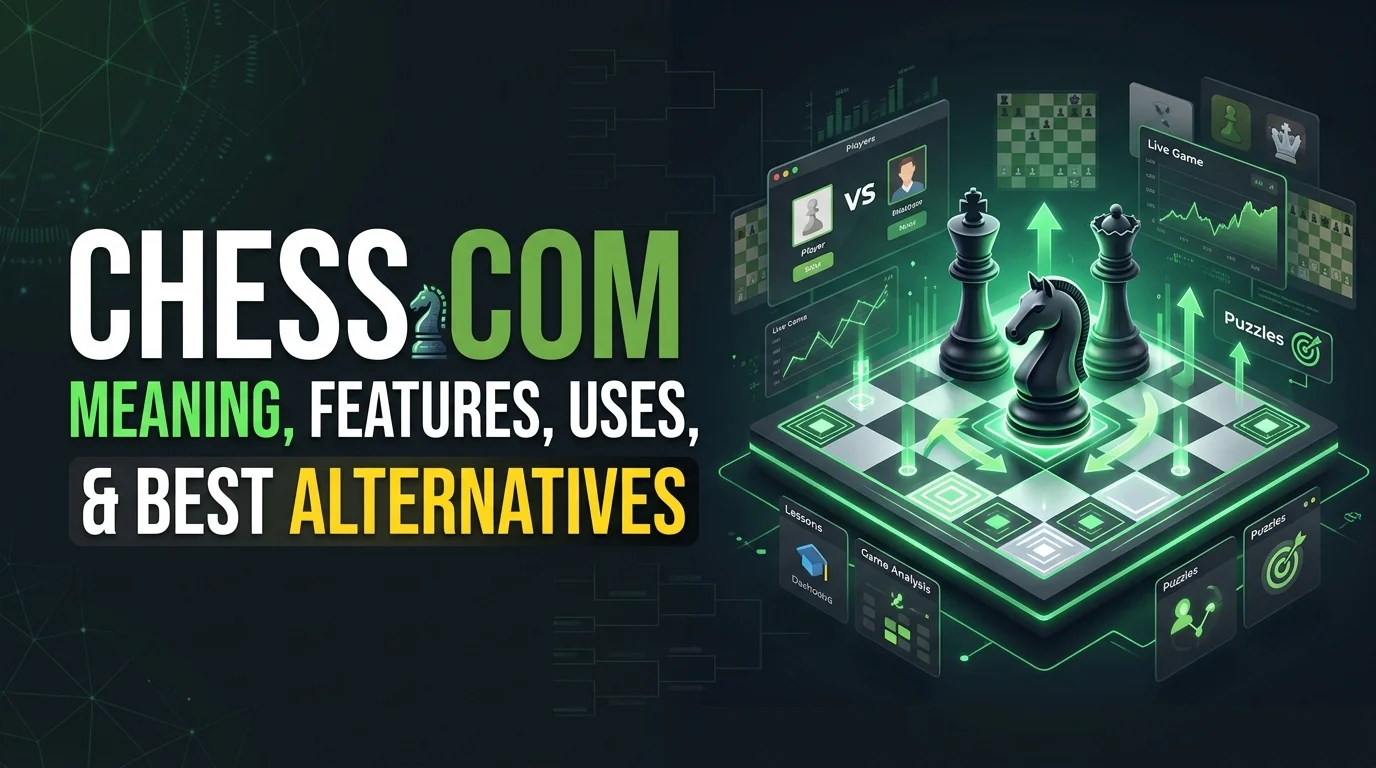
Chess.com is a popular online platform where people can play chess, improve their strategic thinking, solve puzzles, and compete against players from around the world.
Whether you are a complete beginner or an experienced chess enthusiast, the platform offers tools that make learning and playing chess accessible from almost anywhere. Many people search for Chess.com to understand how it works, explore its features, discover its mobile app, or find ways to improve their chess skills.
Unlike traditional chess, which requires a physical board and another person to play with, online chess allows users to start a match within seconds.
Players can compete against friends, challenge computer opponents, participate in tournaments, and review their games to identify mistakes. The platform also provides educational resources, including lessons, puzzles, and game analysis tools.
This article explains what Chess.com means, how it developed, where it is used, how it differs from similar platforms, and which alternatives are worth exploring. It also clears up common misconceptions and explains how to respond when someone mentions Chess.com in an online conversation.
1. Meaning and Definition of Chess.com
Chess.com is an online chess platform designed to help people play, study, and enjoy the game of chess. The name combines the word “chess,” referring to the strategic board game, with the “.com” internet domain commonly associated with commercial websites.
In simple terms, Chess.com is a website and digital gaming service that brings traditional chess into an online environment. Instead of arranging pieces on a physical board, users make moves through an interactive digital board using a computer, tablet, or smartphone.
What can you do on Chess.com?
The platform offers several features for different skill levels:
- Play online chess: Compete against other players in games with different time controls.
- Challenge computer opponents: Practice against chess engines at different difficulty levels.
- Solve chess puzzles: Improve pattern recognition, tactics, and calculation.
- Study chess lessons: Learn openings, middle-game strategies, and endgame techniques.
- Analyze completed games: Review moves, identify mistakes, and explore stronger alternatives using available analysis tools.
- Join tournaments: Participate in organized competitions and online chess events.
- Follow chess news: Explore articles, professional tournaments, and chess-related discussions.
- Connect with other players: Add friends, send challenges, and participate in chess communities.
Some features are available without payment, while others require a premium membership or have usage limits that may vary by plan.
Who uses the platform?
Chess.com attracts a wide range of users, including students, casual gamers, chess coaches, competitive players, and people who simply enjoy solving strategic problems. Beginners can learn the rules and develop basic skills, while advanced players can study complex positions and prepare for serious competitions.
The platform is also useful for people who want a flexible hobby. A quick game can fit into a short break, while longer matches and structured lessons provide opportunities for deeper learning.
Ultimately, Chess.com is more than a place to play a board game. It combines entertainment, education, competition, and community in one online environment.
2. Background and Development
Chess has existed for centuries, evolving through different cultures before becoming the internationally recognized game played today. As internet access expanded, chess gradually moved from physical boards and local clubs into digital spaces where people could compete regardless of geographical distance.
Chess.com emerged during this transition, providing an online destination specifically focused on chess. Its purpose was to make playing the game easier while giving users access to learning resources and a community of fellow enthusiasts.
Over time, online chess became increasingly popular because it removed several traditional barriers. Players no longer needed to arrange a meeting, travel to a chess club, or own a physical board to practice regularly. An internet connection and a compatible device were enough to get started.
How the platform evolved
As digital gaming developed, Chess.com expanded beyond basic player-versus-player matches. Features such as computer opponents, tactical puzzles, instructional lessons, game analysis, tournaments, and social interaction helped make the platform useful for both entertainment and serious study.
Mobile access also made a difference. Players could enjoy a short match while traveling, practice puzzles during breaks, or review a game without sitting at a desktop computer.
The growth of online streaming and video content further increased interest in chess. Professional competitions, educational creators, online tournaments, and popular chess personalities introduced the game to audiences who might never have considered joining a traditional chess club.
Chess.com became part of this broader shift by bringing playing, learning, watching, and discussing chess together.
The role of online chess in modern gaming
Online chess demonstrates how a traditional activity can adapt to modern technology without losing its essential character. The rules and strategic principles remain recognizable, but digital tools make it easier to find opponents, record games, and review performance.
The platform also illustrates the value of online communities. Players can meet people with similar interests, compare ratings, discuss strategies, and learn from stronger opponents.
Although the technology surrounding chess continues to change, the central appeal remains the same: every game presents a new problem that requires planning, patience, and decision-making.
For these reasons, Chess.com is relevant not only to chess enthusiasts but also to people interested in online gaming, skill development, and digital communities.
3. Uses in Different Contexts: Gaming, Education, and Professional Fields
Chess.com is primarily associated with online chess, but its uses extend into education, recreation, competitive gaming, and professional chess training. Understanding these different contexts helps explain why people with very different interests use the same platform.
Gaming and entertainment
For casual players, Chess.com offers a convenient way to enjoy chess without needing a physical opponent. Users can choose quick games, longer matches, or computer challenges depending on their available time and experience.
Online chess also creates a competitive gaming environment. Ratings, leaderboards, tournaments, and timed matches encourage players to measure their progress and challenge themselves.
Some people use the platform purely for fun, while others enjoy the satisfaction of improving their rating or solving difficult puzzles.
Education and learning
Chess can help learners practice concentration, logical reasoning, planning, and recognizing patterns. Chess.com supports these activities through lessons, puzzles, and game reviews.
Teachers, parents, and chess coaches may use online chess tools to introduce rules, demonstrate positions, or organize practice. However, chess should not be treated as a guarantee of improved academic performance; the educational benefits depend on the learner and how the activity is used.
Beginners can start with basic piece movements and gradually progress to more advanced concepts such as tactical combinations, opening principles, and endgame technique.
Competitive and professional chess
Serious players may use Chess.com to practice regularly, analyze games, prepare against common openings, and compete in online events. Coaches can also discuss positions and review students’ games using digital boards and analysis tools.
Online chess has created additional opportunities for tournaments, commentary, live broadcasts, and chess-related content creation. Professional players and streamers can reach international audiences without relying entirely on in-person events.
However, online ratings are not directly interchangeable with over-the-board ratings because playing conditions, player pools, and rating systems differ.
Workplace and social settings
Chess.com can also be a recreational activity among colleagues, friends, and online communities. A quick game may provide a shared interest or an informal way to connect.
The platform is not primarily a professional networking service, but chess can appear in team-building activities, educational programs, and discussions about strategy.
Across these settings, the main purpose remains consistent: to make chess easier to play, study, and share with other people.
4. What Does Chess.com Mean in Chat, WhatsApp, Instagram, and TikTok?
When someone mentions Chess.com in a message or social media post, they are usually referring to the online chess platform. Unlike internet slang or abbreviations, Chess.com does not have a separate, widely established meaning in everyday texting.
Its meaning can still change slightly depending on the conversation. Someone discussing gaming may use the name to suggest playing a match, while a content creator might mention it when sharing a chess challenge or funny game moment.
Chess.com in chat messages
In private messages, the platform’s name often appears when friends want to play chess or discuss a recent game.
Examples:
- “Are you free for a Chess.com match?”
- “I finally reached a new rating on Chess.com!”
- “Send me your Chess.com username.”
- “I lost three games in a row today.”
- “Let’s play chess instead of scrolling all evening.”
These messages use the name literally, referring to the website or its app.
Chess.com on WhatsApp
On WhatsApp, people may share game invitations, screenshots, usernames, tournament updates, or links to chess games. A friend might send a message asking you to join a match or help analyze a difficult position.
For example, “I found a brilliant move today. Check out my game!” could accompany a link to a completed match.
The platform’s name does not automatically indicate a special WhatsApp abbreviation or hidden message. The surrounding conversation determines the intended meaning.
Chess.com on Instagram
Instagram users may post chess achievements, puzzle solutions, tournament photographs, or short clips showing surprising moves. The platform may be mentioned in captions when someone shares an online game or invites followers to play.
Typical caption ideas include:
- Chess mode: activated.
- One move can change everything.
- Learning something new, one game at a time.
- Strategy first, victory second.
- A little chess, a lot of thinking.
These examples show how the platform can become part of a person’s online identity or hobby-related content.
Chess.com on TikTok
On TikTok, Chess.com may appear in humorous chess videos, puzzle challenges, beginner tutorials, reaction clips, or recordings of unexpected mistakes. Creators sometimes combine chess footage with comedy, storytelling, and commentary to make the game entertaining for a broader audience.
For example, a video might show a player confidently making a move before realizing it allows an immediate checkmate.
The key takeaway: In chat and social media, Chess.com generally refers to the chess platform itself. Any humor, sarcasm, or additional meaning comes from the surrounding content rather than the name alone.
5. Does Chess.com Have a Meaning in Physics, Medical, or Aircraft Terminology?
People searching for unfamiliar terms sometimes encounter the same letters or words across unrelated subjects. This can create confusion when a website name appears alongside technical vocabulary.
Chess.com is not a standard physics unit, medical abbreviation, or recognized aircraft terminology term. Its ordinary meaning is associated with the online chess platform.
Chess.com in physics
Physics uses established symbols, equations, units, and technical terminology to describe matter, energy, motion, electricity, and other natural phenomena.
The word “chess” may appear in an analogy about strategic decision-making or mathematical problem-solving, but Chess.com itself is not a standard physics concept.
Chess positions can be studied mathematically using ideas such as probability, search algorithms, combinatorics, and artificial intelligence. These are legitimate areas of mathematical and computational research, but they do not make the website name a physics term.
For example, a student might compare planning several chess moves with exploring possible outcomes in a decision-making model. That is an analogy, not a special scientific definition.
Chess.com in medical terminology
Medical terminology includes abbreviations for diseases, diagnostic procedures, medications, anatomical structures, and clinical measurements. Chess.com is not a standard medical diagnosis or universally recognized clinical abbreviation.
Chess may be used in recreational programs, educational activities, or research exploring cognition and problem-solving. However, playing chess should not be presented as a substitute for medical treatment or as a guaranteed method of preventing cognitive decline.
If you see the letters “chess” or “com” in a medical document, examine the full sentence and the document’s context before assigning a meaning. A similar-looking abbreviation could refer to something entirely unrelated.
Chess.com in aircraft and aviation terminology
Aviation uses standardized terminology for aircraft systems, navigation, flight operations, communication, and safety procedures. Chess.com is not a standard aircraft component or recognized aviation code.
The word “chess” could appear in a pilot’s personal interests, a training analogy, or an unrelated website reference, but this does not establish an aviation-specific definition.
Likewise, “.com” is an internet domain ending, not an aircraft classification.
How to interpret unfamiliar technical references
When a term appears in a technical setting, use these practical steps:
- Read the complete sentence rather than interpreting one word in isolation.
- Identify the subject of the document.
- Check whether the term is defined in a glossary or abbreviation list.
- Consult a reliable specialist reference if the wording affects a technical or medical decision.
- Avoid assuming that every unfamiliar combination of letters has a hidden meaning.
In short, Chess.com has a clear everyday meaning as an online chess platform. Any technical interpretation would require specific contextual evidence rather than guesswork.
6. Common Misconceptions About Chess.com
Because Chess.com is widely associated with online games, beginners sometimes misunderstand what the platform offers, how its ratings work, and whether it is suitable for serious chess improvement.
Clearing up these misconceptions helps users develop realistic expectations before joining.
Misconception 1: Chess.com is only for professionals
One common misunderstanding is that online chess platforms are designed exclusively for highly skilled players.
In reality, Chess.com accommodates different experience levels. Beginners can learn the rules, practice against computer opponents, and solve introductory puzzles. More experienced players can explore complex tactics, study openings, and participate in competitive events.
A person does not need to understand advanced strategies before creating an account or playing a first game.
Misconception 2: You must pay to play chess
Another misconception is that every feature requires a paid subscription.
Users can generally play online chess and access some learning resources without paying. Premium memberships provide additional benefits, but the exact features and limits depend on the current subscription options.
Anyone who is unsure about paying should begin with the free features and decide whether additional tools are worth the cost.
Misconception 3: Your online rating represents your complete chess ability
A rating is useful for estimating performance relative to other players in a particular rating pool and format. However, it does not measure every aspect of chess knowledge or guarantee success in other settings.
Different time controls, platforms, opponents, and rating systems can produce different ratings for the same person.
A player who performs well in fast online games may need additional practice before competing in longer over-the-board tournaments.
Misconception 4: Computer analysis makes learning unnecessary
Game analysis can identify mistakes, suggest stronger moves, and reveal missed opportunities. However, following a computer’s recommendation without understanding the underlying position may provide limited long-term benefit.
Players improve more effectively when they try to explain why a move works, examine alternatives, and connect the lesson to future games.
Analysis is a learning aid, not a replacement for thinking.
Misconception 5: Every online opponent cheats
Suspicious-looking moves can frustrate players, especially when an opponent appears unusually accurate. However, a strong move or unexpected victory is not proof of cheating.
Chess engines, rating systems, and fair-play processes help platforms detect suspicious activity, but individual users should avoid making unsupported accusations.
Misconception 6: Chess.com and chess itself are the same thing
Chess is the game; Chess.com is one digital service through which people can play and study it. The game also exists in clubs, schools, tournaments, homes, and many other online environments.
Understanding this distinction helps users recognize that the platform is a tool for enjoying chess rather than the only way to experience it.
7. Similar Terms and Alternatives to Chess.com
People who discover Chess.com may want to compare it with other chess websites, mobile apps, or traditional playing options. Although these services share the same basic game, their features, communities, interfaces, and pricing structures can differ.
Lichess
Lichess is a popular online chess platform known for offering free chess play, puzzles, analysis, studies, and tournament features. It is particularly attractive to users looking for extensive chess functionality without a required paid subscription.
Its interface and available tools differ from those on Chess.com, so the best choice depends on personal preference.
FIDE Online Arena
FIDE Online Arena is associated with the International Chess Federation’s online chess ecosystem. Its offerings and rating or title-related arrangements may differ from those of general chess platforms.
Users interested in official online chess credentials should check the current eligibility rules and conditions rather than assuming that every online rating is officially recognized.
ChessKid
ChessKid is designed primarily for children and families. It combines chess activities with learning-oriented features and a child-focused environment.
Parents and educators looking for age-appropriate chess learning may find this type of platform more suitable than a general competitive chess service.
Traditional chess clubs
A local chess club offers a different experience from online chess. Players can meet face-to-face, practice over physical boards, receive in-person coaching, and participate in over-the-board competitions.
Clubs can be especially valuable for people who enjoy social interaction or want to prepare for formal tournaments.
Which option should you choose?
| Platform or option | Best suited for |
|---|---|
| Chess.com | Online play, lessons, puzzles, and a large chess community |
| Lichess | Free online chess and extensive study tools |
| FIDE Online Arena | Users interested in its specific FIDE-related online offerings |
| ChessKid | Children and families seeking a learning-focused environment |
| Local chess clubs | Face-to-face games, coaching, and in-person competition |
These are general descriptions, not a claim that one service is better for everyone. Features, policies, and subscription arrangements can change over time.
For a casual beginner, Chess.com or Lichess may be a convenient starting point. Families may prefer a child-focused learning environment, while competitive players might combine online practice with coaching and tournament experience.
The most useful platform is the one that matches your goals, budget, preferred playing style, and desired level of competition.
8. How to Respond When Someone Mentions Chess.com
If someone mentions Chess.com in a message, your response should depend on what they are discussing. They might be inviting you to play, sharing an achievement, asking for your username, or simply talking about a hobby.
You do not need a special response or an understanding of internet slang. A natural reply that matches the conversation is usually enough.
When someone invites you to play
If a friend asks whether you want to play on Chess.com, you can accept, decline politely, or suggest another time.
Examples:
- Sure! Send me an invitation.
- Let’s play. I’m still learning, though!
- Absolutely. Do you prefer blitz or rapid?
- Maybe later. I’ll message you when I’m free.
- I haven’t played before, but I’m willing to try.
These responses keep the conversation friendly without requiring advanced chess knowledge.
When someone shares a chess achievement
If someone tells you that they reached a new rating or won a tournament, acknowledge their effort.
Examples:
- Congratulations! That’s a great achievement.
- Nice work! How long have you been playing?
- That’s impressive. What opening do you usually play?
- Keep going! Your practice is paying off.
- Can you show me the game?
Asking a follow-up question also helps keep the conversation moving.
When someone asks for your username
If you already use the platform, you can share your public username if you are comfortable doing so. If you do not have an account, simply explain that you are new to online chess.
For example, you could say, “I don’t have an account yet, but I’ll check it out.”
You should never share your password, verification codes, or other sensitive account information to arrange a game.
When you do not understand the reference
There is nothing wrong with asking for clarification. You could respond with, “Is that the website where people play chess online?”
This approach is better than pretending to understand something unfamiliar.
The general rule is simple: respond to the person’s actual message. Whether you are discussing a match, celebrating a win, or learning about the platform, a clear and friendly reply works well.
9. Differences Between Chess.com and Similar Terms
Understanding the difference between Chess.com and related expressions helps prevent confusion, particularly when people use the words in gaming discussions or online conversations.
Chess versus Chess.com
Chess is the strategy board game played by two opponents using pieces on an eight-by-eight board. Chess.com is a digital platform where users can play that game and access related services.
For example, saying “I enjoy chess” describes an interest in the game. Saying “I play on Chess.com” identifies a particular platform used to play it.
Chess.com versus online chess
Online chess refers to playing chess over the internet through any compatible service. Chess.com is one platform that provides this experience.
Someone can play online chess using another website, an app, or a digital service. Therefore, the two expressions are related but are not interchangeable in every context.
Chess.com versus a chess engine
A chess engine is software that calculates positions and evaluates possible moves. Engines can help players analyze games, test ideas, and identify tactical opportunities.
Chess.com is a broader service that combines online games, community features, educational resources, and analysis tools. A chess engine may operate within such a platform, but the two serve different purposes.
Chess.com versus a chess rating
A chess rating is a numerical measure used to estimate playing strength within a particular rating system. It is not a website or an individual game.
Ratings can help players find opponents of a similar level and monitor their progress. However, ratings differ across platforms and formats.
Chess.com versus a chess tournament
A chess tournament is an organized competition involving multiple players and games. Chess.com offers online tournament experiences, but tournaments can also take place in schools, clubs, and formal competitive venues.
The tournament is the competition; the platform is one possible place to host or participate in it.
Quick comparison
| Term | Meaning |
|---|---|
| Chess | The strategy board game |
| Chess.com | An online chess platform |
| Online chess | Chess played over the internet |
| Chess engine | Software that analyzes chess positions |
| Chess rating | A numerical estimate of playing strength |
| Chess tournament | An organized chess competition |
These distinctions are useful when reading chess discussions, following online creators, or deciding which tools to use for learning and competition.
10. Chess.com in Online Conversations and Dating Apps
Chess.com can occasionally appear in conversations on dating apps, friendship platforms, and social networking services. In these settings, it usually refers to a shared hobby, an invitation to play, or a playful way to start a conversation.
However, mentioning the platform does not automatically imply romantic interest. Context, tone, and the relationship between the people involved matter more than the website’s name.
Chess as an icebreaker
Some people find it easier to start a conversation around an activity than through generic questions. Chess provides a simple opportunity to discuss interests, challenge each other, or discover a shared hobby.
For example, someone might write:
- “Important question: do you play chess?”
- “Would you rather go for coffee or challenge me to a chess match?”
- “I need someone to help me improve my opening strategy.”
- “Loser buys the coffee. Deal?”
- “Teach me chess, and I’ll bring the snacks.”
These messages can be friendly, humorous, or mildly flirtatious depending on the existing conversation.
Does a Chess.com invitation mean someone likes you?
Not necessarily. A person may invite you to play because they enjoy chess, want a practice partner, or prefer games as a social activity.
If the invitation comes with compliments, playful teasing, or suggestions to spend more time together, it may be part of a broader attempt to build a connection. Even then, one message alone cannot establish romantic intentions.
Look at the overall interaction rather than interpreting a single reference too deeply.
How to respond on a dating app
Your response can reflect your personality and level of interest.
If you enjoy chess, you might say, “I’m in, but don’t blame me if I surprise you.”
If you are a beginner, try, “I’m still learning. Does that mean you’ll go easy on me?”
If you prefer another activity, you can say, “Chess sounds fun, but I’d also be up for coffee.”
You are not required to accept a game invitation just because someone suggests it.
Safety and privacy considerations
When interacting with people you have recently met online, use ordinary digital safety practices. Share only the information you are comfortable making public, avoid revealing sensitive personal details, and be cautious about suspicious links or requests for money.
A chess invitation can be a harmless way to connect, but the same basic online safety principles apply as on any other platform.
Ultimately, Chess.com can provide a shared activity that makes conversations more engaging. Whether the interaction becomes a friendship, a casual game, or a romantic connection depends on the people involved—not on the platform itself.
Conclusion
Chess.com is a versatile online platform that brings chess playing, learning, competition, and social interaction together in one convenient place.
Beginners can explore the rules, solve puzzles, and practice against computer opponents, while experienced players can analyze games, improve their strategies, and participate in competitive events.
The name generally refers to the platform rather than a texting abbreviation or specialized term in physics, medicine, or aviation. In WhatsApp messages, Instagram posts, TikTok videos, and dating app conversations, its meaning depends primarily on the surrounding context.
Someone mentioning Chess.com may be inviting you to play, discussing a recent victory, sharing a chess-related joke, or simply expressing an interest in the game.
If you want to try online chess, you can start with the available free features and explore additional tools as your skills develop.
Comparing alternatives such as Lichess or joining a local chess club can also help you find the experience that suits you best. Ultimately, the best way to understand Chess.com is to explore how it works and enjoy the strategic challenges that make chess engaging.

I Am James Walker writes creative caption ideas, social media tips, and trending content at captionscrafter.com to help users level up posts