The internet is full of unfamiliar website names, digital platforms, and online services that attract attention through search engines and social media. Obsails.com is one such term that people may search for when they encounter the name online and want to understand what it means, what the website offers, or whether it is useful and trustworthy.
When users come across an unfamiliar domain, they often look for basic information before visiting it. They may want to learn about its purpose, possible features, intended audience, and relevance to everyday internet use. Others may be researching the name for educational, technical, or search engine optimization purposes.
It is important to distinguish between a website’s actual, verified function and assumptions based on its name. The word “Obsails” does not, by itself, establish whether the domain is associated with a business, an online tool, a blog, or another type of service.
This guide explores the term, explains how to evaluate an unfamiliar website, and discusses its possible relevance in digital communication. It also clarifies several common misconceptions so readers can make informed decisions without relying on unsupported claims.
1. Obsails.com Meaning and Definition
Obsails.com is a domain name that people may encounter while browsing the web, researching websites, or looking for information about unfamiliar online platforms. To understand it properly, it helps to separate the domain name itself from the services that might be available through it.
A domain name is a website’s human-readable internet address. The “.com” ending is a widely used top-level domain associated with commercial websites, although it can be used for many other purposes. The name before that ending identifies the particular domain.
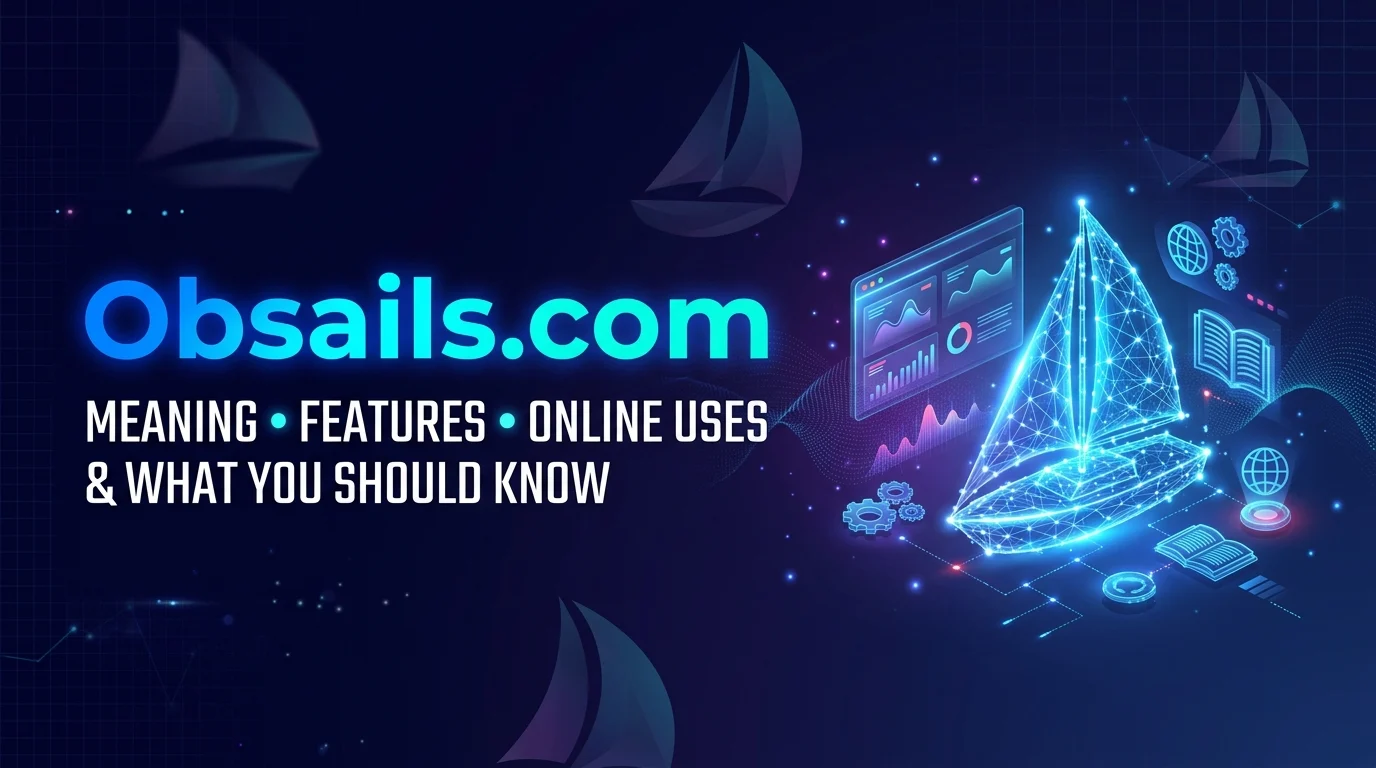
In the case of Obsails.com, the name alone does not provide a confirmed definition or reveal the website’s complete purpose. A third-party article describes it as a sailing-performance platform, but the available information does not independently establish that the claimed technical features are genuine.
What does the name tell us?
- Obsails: The distinctive name used to identify the domain.
- .com: A common domain extension used by businesses, organizations, publishers, and other website owners.
- Obsails.com: The complete domain name that can be used to locate the associated website.
The most reliable way to understand the website is to examine its actual pages, published information, ownership details, and available services.
It is also important to remember that a website’s name is not necessarily an acronym, technical term, or recognized expression. Unless the website owner provides an official explanation, assigning a specific expanded meaning to “Obsails” would be speculation.
For readers researching this term, the key takeaway is simple: Obsails.com is a domain name, while its exact identity and current purpose should be established through verifiable evidence rather than assumptions.
2. Background and Online Presence
Understanding an unfamiliar website involves looking beyond its name and examining its online history. This can include domain records, older references, archived pages, third-party listings, and information published by the website itself.
Publicly indexed information shows that Obsails.com has appeared in historical website-relationship records. These records include shared analytics identifiers associated with multiple domains over certain periods. Such information can offer clues about historical web infrastructure, but it does not establish who owns a website or prove that all associated domains belong to the same business.
A separate third-party article presents Obsails.com as a platform for sailing data and sail-performance analysis. However, descriptions in promotional or informational articles should be checked against the actual service before readers rely on them.
How to research its background
If you want to understand the site’s history, consider these steps:
- Visit the official domain: Check whether the website loads and what information it currently publishes.
- Look for an About page: A clear description of the organization and its purpose can help establish context.
- Check domain registration records: Services such as ICANN Lookup can provide available registration information, although privacy protection may hide the registrant’s identity.
- Review historical pages: Internet archives may help show how the website appeared in earlier years.
- Compare independent sources: Look for consistent descriptions from reputable sources rather than relying on a single article.
- Check contact information: A working business email, company details, and transparent policies can provide additional context.
A website’s history may change over time. It might be redesigned, repurposed, sold, or left inactive. For this reason, older references should not automatically be treated as descriptions of its present-day services.
Ultimately, the background of Obsails.com should be understood through verifiable records and current evidence, not just through the wording of its domain name.
3. Usage in Different Contexts
Obsails.com may appear in different online situations, depending on how someone discovers or references the domain. Understanding the context helps explain why a person might search for it.
Website research and browsing
A person might see the domain in a search result, website directory, article, advertisement, or browser history. They may search for it to learn whether it is a publisher, business, specialist service, or another type of website.
Digital publishing and SEO
Website owners and digital marketers frequently research unfamiliar domains to evaluate their content, topical relevance, audience, and potential usefulness for publishing. A third-party listing offers a sponsored-article placement for Obsails.com and categorizes it under general news, although that listing alone does not establish the quality or current editorial standards of the website.
Before using a domain for guest posting or link building, marketers should evaluate:
- Originality and usefulness of published articles.
- Relevance to the intended audience.
- Transparency about sponsored content.
- Quality of editorial standards.
- Natural, relevant linking practices.
- Evidence of genuine readership and engagement.
A domain name or third-party listing alone cannot establish SEO value.
Professional research
Researchers and business users may investigate a website to understand its industry, credibility, or potential role in a project. The appropriate approach is to verify the service’s identity and capabilities before sharing information or entering into a business relationship.
General internet conversations
Someone might mention Obsails.com in a message simply to share a link or ask another person whether they recognize it. In that situation, the name functions as a website reference rather than a word with a special conversational meaning.
The context, therefore, matters more than the name itself. A domain mentioned in an SEO discussion may have a different purpose from the same domain appearing in a technical article or personal message.
4. Meaning in Chat, WhatsApp, Instagram, and TikTok
People frequently search for unfamiliar words and website names after encountering them in messages or on social media. Obsails.com could be shared through WhatsApp, Instagram, TikTok, Facebook, or another communication platform, but its appearance in a conversation does not establish that it has a special slang meaning.
Unlike common abbreviations such as “BRB” (be right back) or “IMO” (in my opinion), Obsails.com is formatted as a domain name. Its meaning in a message generally depends on the reason the sender included the link.
Obsails.com in chat messages
Someone might send a message such as:
- “Have you heard of Obsails.com?”
- “Can you check what this website offers?”
- “I found this domain while researching websites.”
- “Do you think this link is safe to open?”
In these examples, the sender is referring to a website rather than using a recognized abbreviation.
On WhatsApp
If someone sends the domain through WhatsApp, it could be a recommendation, a question, a business reference, or an unsolicited link. Before opening it, consider whether you recognize the sender and understand why the link was shared.
On Instagram and TikTok
Website names sometimes appear in captions, comments, direct messages, promotional posts, and creator biographies. A mention of Obsails.com in these places should be interpreted according to the surrounding content.
For example, a creator might share a website as a resource, while another user might ask whether the domain is legitimate. Neither situation establishes a universal meaning for the name.
How to interpret the context
| Context | Possible purpose |
|---|---|
| Private message | Sharing or asking about a website |
| Social media caption | Mentioning an online resource |
| Business discussion | Referring to a domain or publisher |
| SEO conversation | Researching website visibility or publishing opportunities |
| Unexpected message | A link that requires careful verification |
These are possible contexts, not confirmed uses of Obsails.com on every platform.
Important: There is no established basis for treating Obsails.com as a universal texting abbreviation, romantic expression, or trending social media slang. If you encounter it in a message, ask the sender what they mean or why they shared the website.
5. Meaning in Physics, Medical, and Aircraft Terminology
Acronyms and specialized terms can have different meanings across scientific, medical, and aviation fields. However, it is important not to assign an invented technical definition to an unfamiliar website name.
Obsails.com is presented as a domain name in the available references. There is insufficient evidence to identify it as a recognized term in physics, medicine, or aircraft terminology.
Physics
Physics uses established terminology to describe matter, energy, motion, forces, and other natural phenomena. Some technical abbreviations are shared across disciplines, but their definitions depend on the specific field and context.
There is no verified basis here for defining “Obsails” as a standard physics equation, physical quantity, law, or measurement unit. If you encountered the term in a physics document, check the surrounding paragraph, equation, or glossary to determine whether it is a specialized abbreviation or a reference to a website.
Medical terminology
Medical language includes abbreviations for diagnoses, procedures, medicines, laboratory measurements, and clinical organizations. Because misunderstandings in this field can affect health decisions, unfamiliar terms should be verified using reliable medical references or by asking a qualified healthcare professional.
Obsails.com should not be interpreted as a medical diagnosis, treatment, medication, or clinical abbreviation without authoritative supporting evidence.
Aircraft and aviation terminology
Aviation uses standardized abbreviations for aircraft systems, navigation, flight operations, and safety procedures. The same letters can sometimes have different meanings in other industries.
No verified information establishes Obsails.com as an official aviation term, aircraft component, flight instrument, or navigation system.
Why context matters
If you encountered the word in a technical manual, medical document, or aviation report, check the source and exact spelling. It could be a typo, a product name, a local abbreviation, or an unrelated reference.
Do not confuse a website’s possible subject matter with a formally recognized technical definition. Accurate terminology requires evidence from the relevant professional field.
6. Common Misconceptions About Obsails.com
Unfamiliar websites often attract assumptions because people want quick answers about their purpose and reliability. The best way to avoid confusion is to separate what is known from what remains uncertain.
Misconception 1: The name has a confirmed full form
A domain name does not automatically represent an acronym. Unless an official source explains the name, there is no reason to assign a specific full form to Obsails.
Misconception 2: It is definitely a sailing technology platform
One published article describes Obsails.com as a sailing-related platform with performance monitoring and data-management features. However, that description should not be treated as independently verified proof that the website provides those services
Misconception 3: A website appearing in search results is automatically trustworthy
Search engine visibility only indicates that a page has been discovered or indexed. It does not guarantee accuracy, security, professional standards, or legitimacy.
Misconception 4: Every unfamiliar domain is dangerous
An unfamiliar name is not proof of malicious activity. Some websites are legitimate but relatively obscure. Their credibility should be evaluated using evidence rather than appearance alone.
Misconception 5: A secure connection proves that a site is legitimate
HTTPS helps protect information exchanged with a website, but it does not prove that the operator is honest or that the site’s claims are accurate.
Misconception 6: Shared analytics records prove common ownership
Historical technical records may reveal shared tracking identifiers, but such overlap does not conclusively establish common ownership, editorial control, or the relationship between websites.
How to avoid these mistakes
Verify the domain’s current content, investigate the operator, review relevant policies, and seek independent evidence before making important decisions. Avoid submitting payment information or sensitive personal details until you have established that the service is trustworthy.
The most accurate approach is to remain open-minded while requiring evidence for specific claims.
7. Similar Terms and Alternatives
When researching Obsails.com, you may encounter other terms that look or sound similar. Understanding the differences can help you avoid confusing unrelated websites, businesses, and technical expressions.
Similar-looking names
- Obsails: The name without the domain extension.
- Obsails.com: The complete domain name.
- OpenSail: A different name used by an established digital marketing agency. Its website describes services such as web design and digital advertising.
- OB Sailing: A separate sailing organization that provides sailing instruction and yacht-related activities in England.
These names should not be treated as interchangeable. Similar spelling does not establish a relationship between organizations or websites.
Alternatives for researching unfamiliar websites
If your goal is to understand a website’s identity or reputation, different tools can help:
| Research need | Useful resource |
|---|---|
| Domain registration information | ICANN Lookup |
| Historical website pages | Internet Archive’s Wayback Machine |
| Website security checks | Google Safe Browsing |
| Technical website information | Public DNS lookup services |
| Editorial credibility | Independent reviews and reputable publications |
| Website ownership and policies | The site’s official About, Contact, and Privacy pages |
Each resource serves a different purpose. Domain registration records can help establish registration details, while historical archives show available snapshots of earlier pages. Security tools can identify certain known threats but cannot guarantee that a website is completely safe.
If you are researching Obsails.com for guest posting, sponsored articles, or backlinks, also examine the website’s content quality and audience relevance. A domain’s value should not be judged solely by its name, apparent age, or a third-party promotional listing.
The best alternative depends on your objective. For general understanding, start with the official website. For credibility, look for independent evidence. For SEO research, examine editorial quality, topical relevance, and the transparency of publishing practices.
8. How to Respond When Someone Mentions Obsails.com
Your response should depend on how the domain appears in the conversation. Since Obsails.com is not an established slang expression, you do not need to interpret it as a hidden message or special abbreviation.
If someone sends you the link
You can ask:
- “What is this website about?”
- “Can you explain why you shared this link?”
- “Is this an official website or a third-party resource?”
- “Have you used this website before?”
These questions help establish the sender’s intention before you decide whether to visit the site.
If someone mentions it in a professional conversation
If the name appears in an email, business proposal, or SEO discussion, request specific information about its purpose.
For example, if someone offers a sponsored article placement, ask about the intended audience, editorial guidelines, publication terms, and whether links will be marked appropriately. Evaluate the offer on its merits rather than assuming that a website is valuable simply because someone recommends it.
If you receive an unexpected message
Use caution when a stranger sends an unfamiliar domain. Do not provide passwords, payment details, verification codes, or sensitive personal information merely because the sender asks you to.
If the message claims to be from a company, find the company’s official contact information independently rather than relying on an unexpected link.
If you want a short reply
Here are a few natural responses:
- Curious: What is Obsails.com used for?
- Neutral: I haven’t come across this website before.
- Professional: Could you share more information about the site’s purpose and services?
- Cautious: I’ll verify the website before opening the link.
- SEO-related: Do you have information about its audience and editorial standards?
A straightforward question is usually the best response when the purpose of a domain is unclear. It avoids misunderstandings and allows the other person to explain what they intended.
9. Differences Between Obsails.com and Similar Words
It is useful to distinguish between a domain name, a brand name, an acronym, and an ordinary word because each serves a different function.
| Term type | Meaning | Example |
|---|---|---|
| Domain name | An internet address | Obsails.com |
| Brand name | A name used to identify a business or product | A company’s registered brand |
| Acronym | A word formed from initial letters | NASA |
| Initialism | An abbreviation pronounced letter by letter | FAQ |
| Technical term | A word with a specialized meaning in a field | Velocity in physics |
| Internet slang | An informal expression used in digital communication | BRB |
Obsails.com fits the domain-name category based on its format. Whether the name is also used as a brand or product name depends on evidence about the organization behind it.
Why the distinction matters
A search for a website name is different from a search for a dictionary definition. Someone searching for a slang expression generally wants to understand how people use it in conversation. Someone searching for a domain often wants to discover the website’s services, reputation, or ownership.
Likewise, a technical abbreviation should be interpreted according to the relevant field and source. It would be misleading to create a physics, medical, or aviation definition for Obsails.com without authoritative evidence.
How to identify the correct meaning
Start by checking where the term appeared. If it was written as a clickable address, it probably refers to a website. If it appears in a technical document, examine the glossary and surrounding sentences. If it appears in a casual conversation, ask the sender for clarification.
Spelling also matters. A small difference in a domain name can lead to an entirely different website, so verify the exact address before entering personal information.
Understanding these distinctions makes online research more accurate and reduces the risk of confusing unrelated terms or organizations.
10. Relevance in Online Conversations and Dating Apps
Website names can appear in conversations on dating apps, social networks, and messaging platforms. However, the presence of Obsails.com in a private message does not automatically reveal anything about the sender’s personality, intentions, or relationship interest.
When a match shares the domain
If someone on a dating app sends Obsails.com, they might be sharing an article, discussing a hobby, recommending a resource, or simply asking whether you recognize the name. The surrounding conversation provides more useful information than the domain itself.
A natural response might be:
“I’m not familiar with that website. What made you want to share it?”
This gives the other person an opportunity to explain the link without making assumptions.
How to evaluate unfamiliar links
Online dating involves communicating with people whose identities and intentions may not yet be fully established. A little caution is sensible, especially when a conversation quickly shifts toward unfamiliar websites.
Consider these practices:
- Avoid links that demand immediate action or create unnecessary urgency.
- Do not enter dating-app passwords into third-party websites.
- Never share verification codes with another person.
- Be cautious if someone asks you to make payments or invest money through a site.
- Stop engaging if a person repeatedly pressures you to reveal sensitive information.
These precautions apply to unfamiliar links generally, not specifically to Obsails.com.
Does Obsails.com have a romantic meaning?
There is no established evidence that Obsails.com is a recognized dating abbreviation, flirtatious phrase, or coded expression of affection.
If someone uses the name during a romantic conversation, interpret it in the context of what they say and do rather than assigning a hidden meaning to the domain.
Relevance to digital communication
The broader lesson is that website names are frequently exchanged as part of everyday online communication. Their significance depends on the purpose of the link, the sender’s explanation, and the reliability of the website.
Being curious is perfectly reasonable. Asking questions and verifying unfamiliar websites helps you communicate confidently while protecting your privacy.
FAQs About Obsails.com
1. What is Obsails.com?
Obsails.com is a website domain. Its exact purpose and current services should be confirmed through reliable, up-to-date information.
2. What does Obsails.com mean?
Obsails.com is a domain name, not a widely recognized slang expression. The name alone does not establish a specific meaning.
3. Is Obsails.com a legitimate website?
Its legitimacy cannot be confirmed from the domain name alone. Review its ownership information, policies, website content, and independent sources before using it.
4. Is Obsails.com safe to visit?
Do not assume that an unfamiliar website is safe. Check the URL, use a reputable website security checker, and avoid submitting sensitive information without verification.
5. What is Obsails.com used for?
Its current purpose is not conclusively established by the available information. Check the website itself and reliable independent references for confirmation.
6. Is Obsails.com a sailing website?
A third-party article describes it as a sailing-related platform, but that description should be independently verified before being treated as fact.
7. Is Obsails.com an acronym?
There is no verified evidence establishing an official expanded form for the name.
8. Can I use Obsails.com for SEO or guest posting?
Evaluate its content quality, audience relevance, editorial standards, and link policies before considering a publishing or backlink opportunity.
9. Does Obsails.com have a meaning in texting?
No widely established texting meaning is verified. In messages, it most likely refers to the website itself.
10. How can I learn more about Obsails.com?
Check its current pages, available domain records, archived versions, and independent sources to develop a more reliable understanding of the website.
Conclusion
Obsails.com is a domain name that people may search for to understand its purpose, online presence, and credibility.
Although third-party sources provide some information about the website, its current services should be verified before making assumptions.
If you encounter this domain, review its content, contact details, privacy policy, and other available information to better understand its purpose. Avoid sharing sensitive information until you feel confident about the website’s legitimacy.
If you are researching it for general knowledge or SEO purposes, rely on trustworthy evidence rather than speculation. Careful research helps you make informed and safer online decisions.