The internet offers countless websites designed to help people browse, communicate, and manage their digital privacy. HidingMe com is a domain name that people may search for when trying to understand a website, identify its purpose, or learn whether it offers privacy-related services. When users encounter an unfamiliar online platform, they often want to know what it does, how it works, and whether it is safe to use.
The name “HidingMe” may suggest privacy, anonymity, or tools for keeping online activity less visible. However, a domain name alone cannot confirm the website’s actual services, features, ownership, or security standards. These details should be verified by examining the current website and reliable independent information.
This article explains the meaning of the domain, its possible interpretations, common online contexts, and the importance of digital safety. It also explores how website names differ from internet slang and technical terminology. Whether you discovered the domain through a search engine, social media post, or private message, this guide will help you evaluate unfamiliar online resources more confidently.
1. HidingMe com: Meaning and Definition
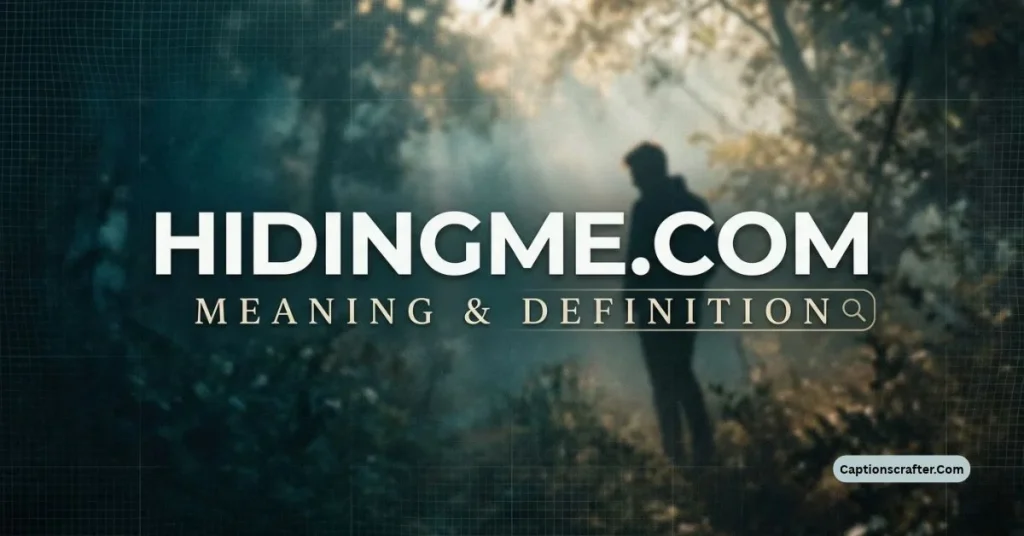
HidingMe com is a domain-name keyword consisting of the distinctive name “HidingMe” and the “.com” extension. Understanding its meaning requires separating the words themselves from the services a website might actually provide.
The word “hiding” generally describes keeping something out of sight or making it less noticeable. “Me” refers to the speaker or person being discussed. Together, the words may suggest protecting personal identity or making someone’s online presence less visible.
The “.com” extension is a widely used domain ending. Although it was originally associated with commercial organizations, it is now used by businesses, blogs, information websites, and many other online projects.
What might people expect from a website with this name?
Based on the wording alone, visitors might expect a privacy-related service, an anonymity tool, or information about protecting personal details online. These are interpretations of the name, not verified descriptions of the actual website.
To determine what HidingMe com genuinely offers, users should examine its homepage, About page, service descriptions, privacy policy, and contact information. If the website provides a particular tool, its documentation should explain what information it processes and what protection it offers.
Why do people search for this domain?
Common reasons include:
- Finding the website after seeing its name in a message.
- Understanding the site’s purpose and available features.
- Checking whether the platform is legitimate.
- Learning whether it protects privacy or anonymity.
- Looking for reviews, support information, or usage instructions.
- Determining whether the website requires registration or payment.
The most accurate definition is straightforward: HidingMe com is a domain name whose actual purpose must be established through reliable evidence. Its wording may suggest privacy, but the name itself does not prove that it provides secure or anonymous browsing.
2. Background and Website Context
Domain names are an essential part of how people navigate the internet. Instead of memorizing numerical IP addresses, users can enter recognizable names into their browsers. Website owners often choose names that are short, memorable, and related to the audience or service they want to reach.
HidingMe appears to combine familiar English words associated with concealment and personal identity. This type of naming can be attractive for projects related to privacy, personal security, anonymous communication, or digital tools. Nevertheless, branding is not reliable evidence of a website’s actual function.
The precise launch date, operator, history, and business model of HidingMe com should not be assumed without verification. A domain can exist before its website becomes active, change ownership, redirect to another destination, or be repurposed over time.
How to investigate its background
If you want to understand the website’s history, start with these steps:
- Check the current website: Confirm that the domain resolves to a functioning page and review the content it displays.
- Read the About section: Look for information about the organization, purpose, and intended audience.
- Review the privacy policy: Determine what personal information may be collected, stored, or shared.
- Inspect contact details: Look for a working support channel and a clearly identified operator.
- Check registration information: ICANN Lookup may provide available domain-registration details, although privacy protection can limit the information shown.
- Look for independent references: Reviews and security reports may provide additional context, but assess their reliability.
These checks can help establish whether the site is active and transparent, but none provides an absolute guarantee of trustworthiness.
It is also important to distinguish domain registration from business legitimacy. A registered domain does not automatically represent a verified company, and a private registration record does not necessarily indicate suspicious activity.
For anyone researching HidingMe com, the best approach is to use current evidence rather than rely on assumptions based on the name. If the site’s content or ownership cannot be verified, acknowledge that uncertainty before trusting it with personal information.
3. Usage in Different Contexts: Chat, Social Media, and Professional Fields
A domain name can appear in different online environments, and the reason for mentioning it depends on the conversation. HidingMe com might be referenced in a private message, a social media post, a technical discussion, or a workplace conversation. Each setting creates a different reason to investigate the link.
Everyday conversations
In personal chats, someone may share a website because they found it useful or want another person to explain what it does.
Examples include:
- “Have you heard of HidingMe com?”
- “Someone sent me this link. Do you know what it is?”
- “Can you check whether this privacy website is trustworthy?”
These statements show curiosity about a website. They do not establish that the domain has a special meaning in everyday language.
Social media
Website links are commonly shared through Instagram bios, TikTok profiles, Facebook posts, YouTube descriptions, and direct messages. A creator might mention a site while discussing privacy, technology, or online tools.
However, a social media recommendation should not replace independent research. Check whether the destination matches the post’s description, whether the account appears authentic, and whether the website makes realistic claims.
Professional environments
In professional settings, a privacy-related website might be discussed during cybersecurity research, digital marketing, software development, or information management.
An IT specialist may examine its security configuration, while a marketing professional might evaluate its content and intended audience. A privacy officer may focus on data collection, retention, and third-party sharing.
The appropriate assessment depends on the intended use. A website that is suitable for reading general information may not be appropriate for processing confidential company documents.
Online research
Search engines can surface domain names because people want to navigate directly to a website or investigate an unfamiliar service. Search intent may therefore be navigational, informational, or safety-related.
Understanding this distinction helps users find the right information. Someone who wants to visit a website needs its correct address, while someone deciding whether to trust it needs evidence about ownership, functionality, and security.
In every context, the domain name is only the starting point. The website’s actual behavior and independently verifiable information should guide the final decision.
4. Meaning in Chat, WhatsApp, Instagram, and TikTok
HidingMe com is a domain name, not a widely established texting abbreviation. Its appearance in a message does not automatically give it a separate slang meaning.
HidingMe com in WhatsApp
People often share links through WhatsApp when recommending resources or asking questions. If someone sends HidingMe com without explaining it, ask what the website is intended to do.
For example:
“Someone shared HidingMe com with me. Do you know what this site offers?”
This is a request for information about a website, not an example of a recognized WhatsApp abbreviation.
HidingMe com on Instagram
On Instagram, a domain might appear in a profile bio, Story, caption, or direct message. If the link is presented as a privacy tool, check whether the actual website explains its capabilities and limitations.
Be cautious if an unfamiliar account promises complete anonymity or asks you to provide your Instagram password to activate a service. A legitimate privacy tool should explain its requirements clearly and should not needlessly request credentials for unrelated accounts.
HidingMe com on TikTok
A creator may mention a website in a video, comment, or profile link. Viewers may search for the domain because they want to verify a recommendation or understand a claim made in the video.
Popularity is not proof of safety. Before using a promoted service, review its terms, privacy policy, and independent reputation.
Does the name have a special slang meaning?
There is no reason to assume that HidingMe com has a standard meaning in internet slang simply because it appears in a casual conversation. The sender may be sharing a website, referring to a specific service, or using the name in a private context.
If the intention is unclear, a simple question is sufficient: “What is this website for?”
This approach avoids guessing and helps distinguish a domain reference from a joke, promotional message, or potentially misleading claim.
5. Meaning in Physics, Medical, and Aircraft Terminology
The words in a website name can resemble technical language without being recognized scientific or professional terminology. HidingMe com should therefore be treated as a domain name unless reliable evidence establishes a particular technical application.
Physics
Physics uses established terminology to describe matter, energy, motion, forces, and other natural phenomena. The word “hiding” may appear informally when explaining concealment or the reduced visibility of an object, but it is not enough to identify a specific physical process.
In optics, for example, visibility can be affected by light absorption, reflection, scattering, and the properties of materials. None of these concepts establishes a connection between HidingMe com and a physics-related service.
Medical terminology
In healthcare, privacy is important when handling medical records, patient identities, and confidential communications. However, HidingMe com is not automatically a recognized medical diagnosis, treatment, medication, or clinical procedure.
If a website makes health-related claims, verify its sources, authors’ qualifications, and evidence. Do not rely on an unfamiliar domain for medical decisions without consulting appropriate professional guidance.
Aircraft and aviation terminology
Aviation includes specialized terms for aircraft systems, flight operations, navigation, and maintenance. The word “hiding” might appear in general discussions about visibility or concealment, but that does not make the domain an established aviation term.
Any claim that a website provides aviation services or technical information should be evaluated using its actual content and recognized aviation references.
Why these distinctions matter
A domain name may be selected for branding rather than technical accuracy. Similar wording does not establish that a website belongs to a scientific, medical, or aviation field.
When researching technical subjects, rely on recognized textbooks, peer-reviewed publications, government resources, or established professional organizations. Treat HidingMe com according to its verified purpose, not assumptions drawn from its name.
6. Common Misconceptions About HidingMe com
Unfamiliar domains can generate misunderstandings, particularly when their names suggest privacy or security. The following points help separate reasonable questions from unsupported conclusions.
Misconception 1: The website definitely hides your identity.
A privacy-related name does not prove that a service masks an IP address, prevents tracking, or protects personal information. These capabilities require technical and policy verification.
Misconception 2: Every .com domain belongs to a registered business.
The .com extension is available to many kinds of website operators. It does not independently establish corporate registration or business legitimacy.
Misconception 3: HTTPS means the website is completely safe.
HTTPS helps encrypt the connection between a browser and a website. It does not prove that the operator is trustworthy or that the service handles information responsibly.
Misconception 4: An unfamiliar domain is automatically dangerous.
New or lesser-known websites can be legitimate. Evaluate the evidence rather than making a decision based solely on unfamiliarity.
Misconception 5: Privacy tools guarantee complete anonymity.
Different tools protect against different forms of tracking. Browser settings, VPNs, proxies, and privacy-focused browsers have different capabilities and limitations. None should be assumed to provide universal anonymity.
Misconception 6: Positive reviews guarantee reliability.
Reviews can be outdated, biased, or fabricated. Consider the source, date, technical evidence, and consistency of independent reports.
Misconception 7: A privacy policy proves that data will never be shared.
A policy describes stated practices, but users should read the details and determine what information is collected, why it is needed, and whether it is shared with third parties.
A careful assessment should consider transparency, technical behavior, permissions, data handling, and independent evidence. If important details cannot be verified, avoid sharing sensitive information until you understand the risks.
7. Similar Terms and Alternatives
People researching HidingMe com may encounter terms associated with privacy, anonymity, and online security. Although these concepts overlap, they do not all mean the same thing.
Privacy tools
Privacy tools help limit unnecessary data collection, tracking, or exposure of personal information. Examples include tracker blockers, privacy-focused browser settings, and services that help users control permissions.
VPNs
A virtual private network, or VPN, routes network traffic through a VPN provider’s infrastructure. It can help protect traffic on certain networks and change the IP address visible to some websites. However, it transfers some trust to the VPN provider and does not guarantee complete anonymity.
Proxy services
A proxy acts as an intermediary between a user’s device and another internet service. Depending on its configuration, it may change the IP address presented to the destination, but it may not encrypt all traffic.
Private browsing
Private or incognito browsing generally limits the information saved locally by the browser after a session ends. It does not automatically hide activity from websites, internet service providers, employers managing a network, or other monitoring systems.
Privacy-focused browsers
These browsers may offer tracker blocking, cookie controls, or other privacy protections. Their features vary, so users should examine the browser’s documentation and settings.
Alternatives for evaluating a website
If your goal is to investigate HidingMe com, consider these resources:
- ICANN Lookup: Check available domain-registration information.
- Google Safe Browsing: Review available information about unsafe websites.
- VirusTotal: Examine available URL reputation and security-detection results.
- Official documentation: Understand the service’s stated features and limitations.
- Independent technical reviews: Look for transparent testing methods and credible evidence.
These resources serve different purposes. A security scan does not confirm that a business is legitimate, while registration information does not establish whether a service protects privacy effectively.
Choose tools according to your goal and avoid assuming that similarly named domains are connected unless that relationship can be verified.
8. How to Respond When Someone Shares HidingMe com
If someone sends you HidingMe com, your response should depend on the context and the reason for sharing it. You can ask questions without being confrontational or assuming the sender has bad intentions.
If you are curious
Try a simple response:
- “What does this website do?”
- “Why did you send me this link?”
- “Is there a particular feature you recommend?”
- “Do you know who operates this website?”
These questions help clarify the sender’s intention.
If you are concerned about privacy
You might say:
- “I’d like to check its privacy policy before using it.”
- “Can you explain what information the website requires?”
- “I’ll verify the service before creating an account.”
These responses communicate sensible caution without accusing anyone.
If the link looks suspicious
Avoid entering passwords, payment details, authentication codes, or identity information. Do not download unknown files simply because the sender encourages you to do so.
If the message claims to represent a known company, visit that company’s independently verified website rather than relying on an unexpected link. If you have already entered a password on a suspicious page, change it through the legitimate service and enable multifactor authentication where possible.
If the sender pressures you
Repeated demands to act immediately, make payments, or reveal confidential information are reasons to pause. You can end the conversation, block the sender, or report suspicious behavior through the relevant platform.
The goal is not to reject every unfamiliar website. It is to understand what the link does and whether the requested action is appropriate before proceeding.
9. Differences Between Similar Words and Website Concepts
Several internet terms are closely related to HidingMe com but have distinct meanings.
| Term | Definition | Main distinction |
|---|---|---|
| Domain name | A readable internet address | Identifies a web destination |
| Website | A collection of web pages and resources | Contains the actual content or services |
| URL | A complete address for a web resource | Can identify a specific page or file |
| Online privacy | Control over personal information and exposure | Describes a goal or set of practices |
| Anonymity | The condition of not being identifiable | Depends on context and available identifying information |
| Confidentiality | Protection against unauthorized disclosure | Focuses on who can access information |
| VPN | A service that routes traffic through a VPN server | Provides specific network-level protections |
| Proxy | An intermediary between a client and another service | Routes requests according to its configuration |
For example, HidingMe com is a domain name, while a privacy service would be a function offered by a website or application. The terms are not interchangeable.
A service might improve confidentiality without making someone anonymous. Similarly, private browsing can reduce local browser history without hiding all online activity.
These distinctions are important because privacy-related marketing can sometimes use broad language that makes different protections sound identical. Users should look for precise descriptions of what a tool protects, what it cannot protect, and which parties may still see their information.
When comparing services, examine their technical documentation, data-retention policies, permissions, and limitations. A clear explanation of these factors is more useful than a broad promise of being invisible online.
10. Relevance in Online Conversations and Dating Apps
Privacy is an important consideration when people communicate through social media, messaging applications, and dating platforms. Website links may be shared to recommend an article, discuss technology, or suggest a particular online service.
If HidingMe com appears in a dating-app conversation, the link alone does not prove that anything is wrong. Ask what the website offers and decide whether the explanation makes sense.
However, unfamiliar links can also be used in phishing attempts, fraudulent promotions, or schemes intended to move people away from platforms with established safety features.
Be especially careful if someone you recently met:
- Promises guaranteed investment returns or prizes.
- Requests payment to unlock an unexpected reward.
- Asks for passwords, verification codes, or identity documents.
- Pressures you to install unfamiliar software.
- Insists that you visit a website without explaining why.
- Uses emotional pressure to obtain money or confidential information.
These are general online-safety warning signs, not claims about HidingMe com specifically.
If you are unsure, verify the website independently and avoid providing personal information until you understand its purpose. Do not reuse passwords on unfamiliar services, and never share one-time authentication codes with another person.
If the sender becomes aggressive or continues pressuring you, stop responding and consider blocking or reporting the account.
Trust should develop through consistent behavior and verifiable information rather than a single link or recommendation. Maintaining reasonable boundaries allows you to explore legitimate resources without unnecessarily exposing your privacy, finances, or identity.
Conclusion
HidingMe com is a domain-name keyword that may interest people looking for a website’s purpose, privacy-related features, or online safety information. Although its name suggests concealment or personal privacy, the wording alone cannot confirm that the website provides anonymity, protects personal data, or offers any particular service.
Before using an unfamiliar domain, review its actual content, ownership information, privacy policy, and security practices. Independent website-checking resources can provide additional evidence, but no single check guarantees that a platform is trustworthy.
If you encounter the link in a WhatsApp message, social media post, or dating-app conversation, ask for context and verify the destination before taking action. Avoid sharing passwords, payment information, or sensitive personal details when the website’s purpose is unclear.
Ultimately, safe browsing depends on understanding what a service actually does rather than relying on its name or marketing claims. By checking facts, questioning unrealistic promises, and protecting your information, you can make more confident decisions about unfamiliar websites.

I Am James Walker writes creative caption ideas, social media tips, and trending content at captionscrafter.com to help users level up posts